

The first time you walk into a jiu-jitsu academy in Lindenhurst, the belt can feel like the smallest part of the experience and somehow the most intimidating. You’re standing there in a new gi, trying to act calm, while everyone else seems to know exactly what to do with that long strip of fabric.
That’s normal.
Learning how to tie a BJJ belt is often the first skill a new student learns. It isn’t just about keeping your gi closed. It’s your first lesson in attention to detail, discipline, and respect for the art. In Brazilian Jiu-Jitsu, small details matter. A grip angle matters. A hip turn matters. The way you tie your belt matters too.
More Than a Knot Your First Step in BJJ
A new student usually notices three things right away. The mats are clean. The room has structure. And the belt suddenly feels more important than expected.
At our Lindenhurst academy, that moment matters because it sets the tone for everything that follows. You’re not just getting dressed for class. You’re stepping into a tradition that reaches back to 1914, when the Brazilian Jiu-Jitsu belt system and proper tying method took root through the teaching lineage that helped shape BJJ’s development, a history highlighted in this overview of the origins of the belt system and its early development.

Why this small ritual matters
The belt is simple, but it represents a big idea. BJJ asks you to be patient, technical, and coachable from day one. Tying your belt neatly is one of the first chances to practice that mindset.
That’s part of why instruction matters so much. A good coach doesn’t assume you already know the basics. They slow things down, correct the little details, and make sure you understand why each habit matters. That teaching style is a big reason so many beginners from Lindenhurst, West Babylon, North Babylon, Copiague, and West Islip look for clear fundamentals before anything flashy.
Practical rule: If your first class feels confusing, that doesn’t mean BJJ is too hard. It usually means you need better step-by-step coaching.
The Caio Terra approach to fundamentals
Caio Terra, referenced in the academy brief as a 12-time IBJJF world champion, is known for a technical approach that values precision over wasted movement. That philosophy shows up even in something as basic as a belt tie. If the foundation is clean, everything built on top of it gets stronger.
For brand new students, that same principle applies outside grappling too. If you’re adding strength work alongside training, resources on weightlifting safety for athletes can help you think the same way about body awareness and preparation.
If you’re still deciding whether to begin, this guide on how to start Brazilian Jiu-Jitsu is a useful next step for local beginners who want a clearer picture of what training looks like.
The Standard Belt Tie A Korfhage BJJ Foundation
The standard tie is the first version most students should learn. It’s clean, reliable, and easy to repeat once you understand the sequence. What's more, it teaches order. You set the center. You wrap with control. You tie a square knot, not a rushed mess.
Here’s the visual most beginners need. Your belt should sit flat around your waist, with the midpoint placed 2 to 3 cm below the navel. When tied correctly with the standard square knot, this method can reach 98% retention in high-level practice, and the common granny knot has a 60% higher failure rate, as explained in this guide to the standard square knot method and common knot errors.
A visual helps before your hands catch up.

How to set the belt correctly
Start by finding the exact middle of the belt. The easiest way is to hold both ends together and trace down until you reach the center point. Place that midpoint just below your belly button.
Wrap both ends around your waist and bring them behind your back. Let them cross once at the back, then return to the front. As you do this, keep the belt flat. If it twists, untie it and reset. A flat wrap grips better and feels better.
A lot of beginners rush this part. Don’t. If the belt starts crooked, the knot will finish crooked.
Building the knot
Once both ends are back in front, one end will sit on top of the other. Take the top end and pass it under both layers of the belt. Pull upward and snug everything down.
Now make the square knot. Cross one end over the other, loop it through, and tighten evenly. The knot should sit flat in the center, not turned sideways, not bunched up, and not slipping down your hips.
A good belt tie feels snug but never distracting. You should notice it once, then forget about it for the rest of class.
This short demonstration can help if you’re a visual learner and want to compare your hands to the movement.
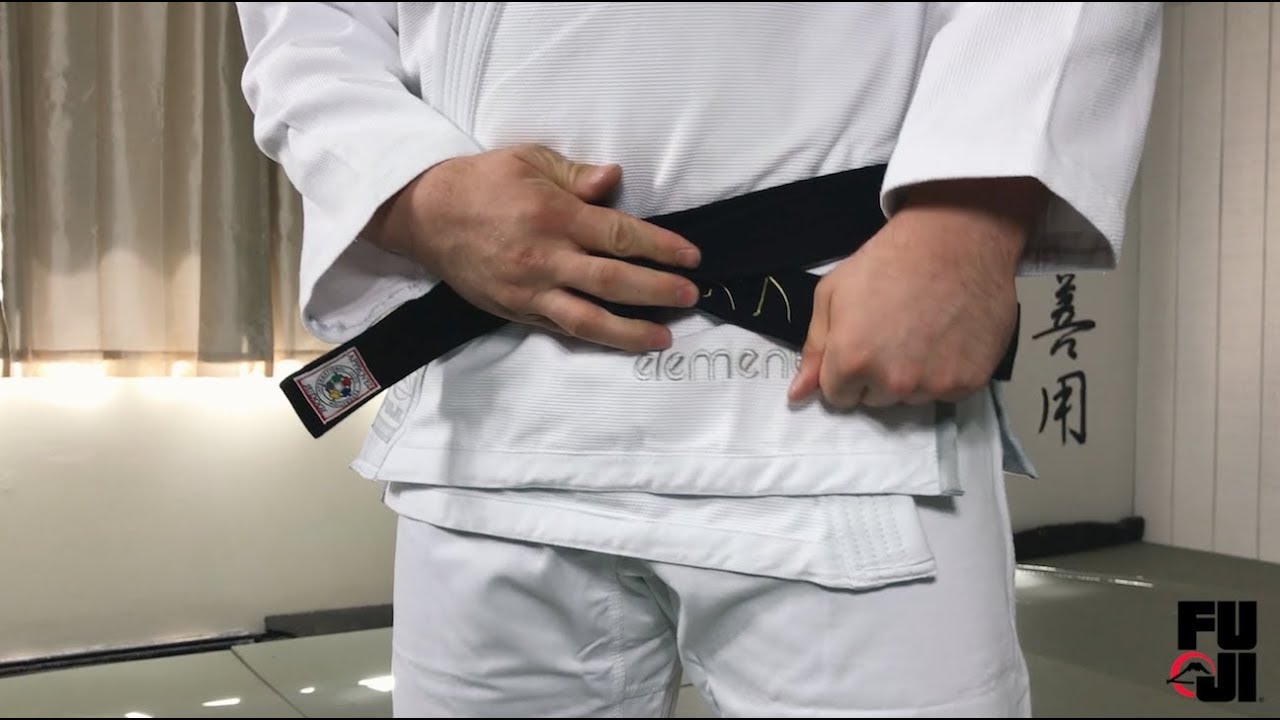
What you should see when you’re done
Use this quick check before class starts:
- Centered knot. The knot should sit in front, not off to one side.
- Even ends. Both tails should hang close to the same length.
- Flat wraps. No twisting around the waist.
- Clean tension. Tight enough to stay on, loose enough to breathe and move.
A lot of BJJ is problem-solving under pressure. This is your first easy version of that lesson. Stay calm, notice the detail that’s off, and fix one thing at a time.
Common Mistakes and Quick Fixes for New Students
Most white belts think a belt comes undone because they didn’t pull hard enough. That’s only part of the story. Usually, the primary problem is sequence, not effort.
The most common mistake is tying a knot that looks close to correct but isn’t. That’s the granny knot. It happens when you reverse the final crossing pattern. The knot may look acceptable for a second, but once you start moving, it loosens fast.

Where beginners usually get stuck
Not every student has the same build, and that affects how the belt behaves. About 20% of online forum discussions about belt tying involve complaints of slippage on larger frames or discomfort for older adults, and standard tutorials often miss those body-type adjustments, according to this discussion of belt slippage and comfort issues across body types.
That matters in a local academy because Long Island students aren’t all built the same. Some have broader waists. Some have shorter torsos. Some older adults need a little less compression and a little more careful placement.
Fast fixes that work
Try these corrections instead of just yanking the knot tighter:
- If the ends are uneven, reset the midpoint before you wrap. Don’t try to fix it halfway through.
- If the knot turns sideways, check whether you reversed the final crossing pattern.
- If the belt slides upward, place it slightly lower and make sure the wraps stay flat.
- If you feel pinched, reduce the tension slightly before the final knot and smooth the layers.
Most belt problems are easy to fix when an instructor watches your hands once and gives you one correction.
That’s why coaching matters so much in the beginning. A patient instructor can spot the mistake in seconds. For a new student, that kind of direct feedback removes frustration quickly and helps the basics feel manageable.
The Super Lock Knot for Competition and Law Enforcement
Once the standard knot feels automatic, some students want more security. Competitors often do. Law enforcement students often do too. In those settings, stopping to retie your belt is more than annoying. It breaks focus.
The Super Lock changes the setup by creating more friction around the waist before the final knot is tied. Instead of centering the belt first, you begin with one end set at the hip and wrap the long side around the waist twice. That extra wrap changes how the knot holds under movement.
When the Super Lock makes sense
The main reason people switch is reliability. The Super Lock BJJ belt tie has a failure rate of less than 2% in stress tests, compared to 12% for standard ties, and it can hold for over 200 minutes of rolling, based on this video explanation of the Super Lock belt tie for competition and defensive training.
That makes it a practical option for students doing hard rounds, competition prep, or more duty-focused training. If that’s your track, this page on jiu-jitsu for law enforcement gives more context on how grappling fundamentals apply under pressure.
The feel of the knot is different
You’ll notice two things right away with the Super Lock. First, it takes a little longer to learn. Second, once it’s tied correctly, it tends to stay put through scrambles, shots, top pressure, and repeated stand-ups.
Here’s the basic flow in plain language:
- Start off-center. Place one end near the hip instead of finding the midpoint first.
- Wrap twice. Bring the long end around the waist two times, keeping everything flat.
- Meet at the front. Bring both ends together near the navel.
- Tie the finish carefully. Pass one end under the layers, then complete the final knot cleanly.
If you compete or train for defensive application, a more secure knot removes one small but real distraction.
For most beginners, the standard tie is still the right first lesson. The Super Lock is what you add when your basics are already under control.
Tying Belts for Kids A Parent's Guide
Parents in Lindenhurst, Babylon, West Babylon, and nearby towns usually notice the same thing in a kids class. A loose belt can become the center of a child’s attention very quickly. Once that happens, their eyes leave the instructor and go straight to the knot.
That’s why simplicity works best. Use the standard tie first. Help your child find the middle of the belt, place it at the front, and guide the wrap while keeping the belt flat. Let them help pull the knot snug so they feel involved instead of dressed by someone else.

What parents should focus on
The goal isn’t perfection on day one. The goal is a secure knot, a calm start to class, and a child who can pay attention.
For kids' classes, using a secure knot like the Super Lock can reduce class disruptions by up to 60%, which supports focus and confidence, as noted in this overview of secure belt tying for young practitioners.
A few habits help:
- Hold the midpoint in place while your child wraps the belt.
- Smooth the fabric before the final knot so it doesn’t bunch up.
- Check the knot once before they step on the mat.
- Practice at home so class time feels familiar.
If your child is starting out, this page on kids jiu-jitsu belt basics can help you reinforce the same habits between classes.
Your Belt Represents Your Journey
A BJJ belt holds your gi closed, but that’s the smallest part of its job. Over time, it starts to represent consistency, humility, and all the classes where you kept showing up even when things felt awkward at first.
That’s one reason Brazilian Jiu-Jitsu is so effective. It teaches usable self-defense through mechanical advantage and control, but it also trains patience, awareness, and problem-solving. None of that develops well without good instruction. The right coach helps you build correct habits early, whether you’re an adult beginner, a parent enrolling a child, an older student improving balance, or a professional training for practical application.
Caio Terra’s method has long emphasized precision, efficiency, and fundamentals. That’s a strong lens for beginners because it reminds you that progress doesn’t start with advanced moves. It starts with simple things done well, including learning how to tie a BJJ belt correctly the first time.
If you live in Lindenhurst or within a short drive, your first step is straightforward. Show up, ask questions, and let someone guide you through the basics.
If you’re ready to start training, Korfhage BJJ | Caio Terra Academy Long Island offers Brazilian Jiu-Jitsu instruction in Lindenhurst for beginners, adults, kids, seniors, and law enforcement students. You’ll learn the fundamentals in a clean, structured setting, including the small details that make your first class feel much less overwhelming.