

If you're in Lindenhurst, West Babylon, Copiague, or nearby and you're looking at after-school options, you're probably not just trying to fill an hour. You want your child in something that builds confidence, teaches discipline, improves coordination, and gives them a real way to handle pressure.
That’s where parents start asking about the kids jiu jitsu belt system.
Belts matter because they show progress. They also matter because they tell you whether a school has structure. In Brazilian Jiu-Jitsu, kids don't move up because they showed up a few times and bought a uniform. They progress through clear standards, visible milestones, and steady skill development.
For parents, that makes a big difference. You can see whether your child is learning, maturing, and staying engaged. You can also tell a lot about an instructor by how they handle promotions, safety, and expectations.
Why Brazilian Jiu Jitsu is the Best Choice for Your Child
A lot of parents around Lindenhurst want the same thing. They want an activity that helps a child become harder to intimidate, better at listening, and more confident in unfamiliar situations.
Brazilian Jiu-Jitsu does that better than most activities because it teaches a child to solve problems under pressure without relying on size or aggression. A smaller kid can learn how to control position, escape bad spots, and apply mechanical advantage effectively. That changes how they carry themselves on and off the mat.

Why BJJ works better for many kids
The biggest advantage is that technique comes before force. Kids learn to think, not just react.
That matters for children who are:
- Smaller than their peers and need a practical way to protect themselves
- Highly energetic and benefit from rules, repetition, and focused movement
- Shy or hesitant and need earned confidence instead of empty praise
- Athletic but unfocused and need discipline tied to specific goals
A good BJJ class also teaches children how to lose a round, reset, and try again. That lesson carries over into school, sports, and social situations.
Practical rule: The right martial art for a child isn't the one that looks the flashiest. It's the one they can train consistently, safely, and with measurable progress.
The belt system is part of why kids stay with it. According to BJJ Fanatics on youth jiu-jitsu belt ranking, BJJ has a high global dropout rate before blue belt, up to 90%, so kids' programs use stripes and 13 distinct belts to keep training structured and motivating. That merit-based structure is one reason many parents prefer BJJ when they want discipline and fitness to grow together.
The instructor matters more than the activity
Not every BJJ school teaches kids well.
A strong instructor knows how to make class safe, organized, and age-appropriate. They know when to push, when to slow down, and how to correct behavior without humiliating a child. They also know that a kids class should build skill and character at the same time.
If you're already comparing activities, it can help to look at broader real benefits of playing sports for kids. Sports in general can help with teamwork, routine, and physical development. BJJ stands out because the progress is personal, technical, and visible every time a child ties on their belt.
Learning from the Best The Caio Terra Method at Korfhage BJJ
Parents often ask what makes one academy different from another when both say they teach Brazilian Jiu-Jitsu. The answer is in the teaching method.
Caio Terra is a 12-time IBJJF world champion, and his approach to Jiu-Jitsu has influenced how many serious academies teach fundamentals. The core idea is simple. Technique should be precise, repeatable, and usable by someone who isn't the biggest or strongest person in the room.
What children gain from that approach
For kids, that philosophy matters a lot.
Instead of throwing a child into chaotic movement and hoping they figure it out, the Caio Terra method emphasizes:
- Clean fundamentals before complexity
- Position and control before risky scrambling
- Details that smaller students can use
- Problem-solving under pressure
That creates a calmer learning environment. Kids learn where their hands go, where their weight goes, and why a movement works. They don't just copy motions.
What works and what doesn't
What works is a class where instructors break techniques into manageable pieces, correct details early, and insist on control. Kids improve faster when they understand the reason behind a movement.
What doesn't work is a kids program built around noise, random drilling, or nonstop games with very little technical instruction. Children might leave tired, but they won't build reliable Jiu-Jitsu that way.
Good kids instruction isn't about making class easy. It's about making learning clear.
That’s why parents in Lindenhurst and the surrounding area should pay attention to lineage and teaching standards, not just schedule convenience. A strong curriculum gives children a path. A strong instructor helps them stay on it safely.
Your Childs Jiu Jitsu Journey The Kids Belt Ranks Explained
The modern kids jiu jitsu belt system is designed for children, not borrowed from the adult ranks. That matters because a six-year-old and a fifteen-year-old don’t learn, move, or mature the same way.
The standardized IBJJF youth belt system was established in 2015 for ages 4 to 15 and includes 13 distinct belts, moving from white to gray, yellow, orange, and green, with three divisions in each color group for gradual development, as outlined in the IBJJF ranking system overview.

The belt path in simple terms
Every child starts at white belt. From there, the system expands by age and development level:
| Belt Color | Typical Age Range | Focus of Development |
|---|---|---|
| White | Ages 4 to 15 | Basic movement, listening, posture, base, and class habits |
| Gray | Around ages 4 to 7 | Core positions, escapes, control, and early offensive awareness |
| Yellow | Around ages 7 to 9 | Better coordination, combinations, and tactical understanding |
| Orange | Around ages 10 to 12 | Sharper technique, stronger transitions, and developing personal style |
| Green | Around ages 13 to 15 | Advanced fundamentals, leadership, and preparation for adult ranks |
Within gray, yellow, orange, and green, there are three stages:
- Color-white
- Solid color
- Color-black
So a child doesn’t jump from gray straight to yellow. They move through gray-white, solid gray, and gray-black first. That gives them more achievable goals and lets coaches reward steady growth.
What each stage usually means
White belt is where habits begin. A child learns how to stand on the mat, how to move safely, how to hold positions, and how to follow directions.
Gray belts start connecting defense to offense. They’re not just surviving positions. They begin escaping, retaining guard, and understanding where they should be.
Yellow belts usually show more timing and confidence. They can recognize patterns, react better to resistance, and make smarter decisions during live training.
Orange belts refine details. Their Jiu-Jitsu starts looking more intentional, with better combinations and more control between movements.
Green belts are the highest youth ranks. At this point, the student should show technical depth, maturity, and the ability to train with younger or less experienced students responsibly.
A belt should reflect what a child can do consistently, not what they did once on a good day.
What parents should watch for
Belts are useful, but behavior tells you just as much.
A child is progressing well when you see:
- Better focus in class
- More patience during difficult rounds
- Improved posture and movement
- Respect for partners and instructors
- Real understanding of basic positions
If you want a closer look at early-stage development, this kids BJJ white belt curriculum is a helpful example of what foundational training should include.
Understanding Promotions and How Long They Take
Parents usually want to know two things. How does my child get promoted, and how long is it supposed to take?
The short answer is that promotions in kids BJJ should reward consistency, skill, and maturity. They shouldn't be automatic.

According to Easton Training Center’s explanation of the IBJJF kids belt system, students can earn a stripe for approximately every 8 classes attended over a month after the initial period, and the first promotion to gray-white requires at least 6 months and 5 stripes. That gives kids a clear effort-to-reward connection.
What stripes are really for
Stripes matter because young students need short-term goals.
A belt promotion can feel far away for a child. A stripe gives them something concrete to work toward while they develop the habits that produce long-term improvement.
In a well-run program, stripes usually reflect a mix of:
- Attendance and consistency
- Technical understanding
- Listening and coachability
- Emotional control during training
- Respect for teammates
A child who trains often but doesn't listen may not be ready. A child who knows the moves but creates unsafe rounds may not be ready either.
What parents often misunderstand
The biggest mistake is treating belt promotions like school grades. Jiu-Jitsu doesn't work that way.
Two children can train for the same amount of time and move at different rates. One might be physically coordinated but immature. Another might be calm and focused but need more time to perform under pressure.
That isn't unfair. It's part of what makes BJJ valuable.
Promotions should be predictable in structure, not identical in timing.
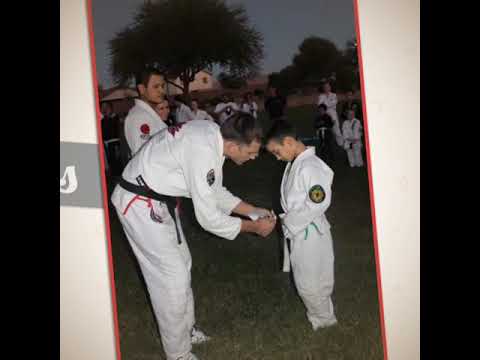
If you want to see examples of promotion ceremonies and hear more about youth progression, this video gives useful context:
How to support progress at home
Parents help most when they support routine without turning belts into pressure.
A few things work well:
- Show up consistently. Missed weeks break momentum fast.
- Ask what they learned. Don’t ask only whether they won rounds.
- Praise behavior. Focus, listening, and resilience matter.
- Be patient. Kids develop in uneven bursts.
What doesn't work is comparing your child to another student or asking for promotions. Instructors see the full picture on the mat. The healthiest kids jiu jitsu belt journey is one where the child wants to improve, not just collect colors.
How to Choose the Right Kids Jiu Jitsu Belt and Tie It
Parents usually overthink the gi and underthink the belt. The belt needs to fit correctly, stay tied, and hold up to regular training.

A properly tied kids jiu jitsu belt should leave 8 to 12 inches on each end after the knot, and sizing is based on waist circumference, with M0 or A0 for under 27 inches, according to the Team Plus One youth curriculum guide. That same guide notes that a secure fit matters because an improper belt can reduce the effectiveness of certain techniques.
Choosing the right belt
Start with waist measurement, not age. Kids grow unevenly, and two children the same age can need completely different sizes.
Look for:
- A snug but comfortable fit so the belt stays in place
- Durable cotton material that can handle repeated tying
- Correct rank color for class and promotion use
If a belt is too long, it flops around and comes loose constantly. If it's too short, it can be hard to tie securely.
How to tie it
The easiest method for most parents is the standard wrap-and-feed knot.
- Find the middle of the belt.
- Place it at the child's navel and wrap both ends around the waist.
- Bring the ends back to the front evenly.
- Feed one end under both layers of the belt.
- Cross the ends and tie a square knot.
- Pull tight and check the tails for even length.
A good knot should sit flat. If one tail is much longer than the other, untie it and reset.
What doesn’t work
Don’t buy oversized belts thinking your child will grow into them soon. That usually creates daily frustration.
Don’t ignore the knot either. A belt that comes undone every round interrupts class and distracts the child. Learning to tie it properly is one of the first small responsibilities a young student can own.
Creating a Safe and Respectful Training Environment
Parents should expect more than instruction from a kids program. They should expect rules, supervision, and a culture that protects children physically and socially.
In Brazilian Jiu-Jitsu, safety starts with control. Children learn to tap when they feel pressure, stop immediately when a partner taps, and avoid treating sparring like a fight. Those habits don't appear by accident. Instructors have to model them and reinforce them every class.
What real safety looks like on the mat
A safe academy teaches:
- Controlled drilling before live resistance
- Clear partner rules so stronger kids don't overpower smaller ones
- Age-appropriate technique selection
- Cleanliness standards for uniforms, nails, and mats
- Constant supervision during sparring
Parents who want a broader look at common concerns can review this guide on whether Brazilian Jiu-Jitsu is safe.
Safety also includes emotional tone. Kids should be corrected firmly when needed, but they shouldn't be mocked, ignored, or thrown into rounds they can't handle.
Respect is part of the curriculum
Mat etiquette isn't extra. It's part of training.
Children learn to:
- Listen when the instructor speaks
- Treat partners respectfully
- Take turns and share space
- Accept correction without attitude
- Help create an orderly class
That structure helps many children far beyond sports. They start understanding that freedom on the mat comes from responsibility, not chaos.
The safest kids classes aren't the ones with the least resistance. They're the ones with the clearest rules.
A respectful room also makes technical learning better. Kids improve faster when they trust their training partners, know what behavior is expected, and understand that control matters more than winning a scramble.
Your Questions About Kids Jiu Jitsu Answered
Is BJJ safe for a smaller or less athletic child
Yes, if the instruction is good.
Brazilian Jiu-Jitsu is built around mechanical advantage, positioning, and timing. A child doesn't need to be explosive or naturally strong to start. In many cases, smaller kids do very well because they learn to use angles and control instead of force.
Can BJJ help a child with ADHD or other neurodiverse needs
It often can, especially when the program adapts thoughtfully.
According to this overview of kids belt flexibility in BJJ programs, a 2025 study in the Journal of Applied Sport Psychology found that neurodiverse children in BJJ programs with belt flexibility showed 35% higher retention, including approaches that award stripes for behavior and self-regulation improvements. In practice, that means some children do better when instructors recognize progress in focus, transitions, and emotional control, not only technical recall.
Will my child be treated like an adult student
No, and they shouldn't be.
Kids need a different pace, different expectations, and different coaching language. The standard should still be high, but the teaching has to match the child's age, maturity, and stage of development.
Should parents focus on belts
Pay attention to belts, but don't obsess over them.
A belt is useful because it marks progress. The deeper value is what your child becomes while earning it: more patient, more coachable, more composed, and more confident under pressure.
Start Your Childs Journey at Korfhage BJJ in Lindenhurst
A good kids jiu jitsu belt system gives children something rare. It gives them a visible path that rewards effort, discipline, and real skill.
For families in Lindenhurst, Copiague, West Babylon, Babylon, and nearby communities, that path matters most when it’s backed by careful teaching and a strong curriculum. The Caio Terra approach emphasizes technical precision, control, and problem-solving, which is exactly what many parents want from a martial arts program.
If you're looking for a local option, youth jiu jitsu near Lindenhurst can give you a clearer sense of scheduling and program fit. Families can also visit the academy at 99 W. Hoffman Ave, Lindenhurst and start with the $99 unlimited classes trial.
The right program should help your child feel challenged, safe, and proud of their progress. That’s what makes the belt journey worth starting.
If you're ready to see whether Brazilian Jiu-Jitsu is the right fit for your child, take the next step with Korfhage BJJ | Caio Terra Academy Long Island.