

If you're in Lindenhurst, West Babylon, Copiague, or a nearby Long Island town, you've probably had the same thought a lot of beginners have the first time they watch a class. Why are some people wearing white belts, others blue or purple, and why does everyone seem to treat those colors with such respect?
That question matters because in Brazilian Jiu Jitsu, the belt around your waist isn't just decoration. It tells a story about time, trust, skill, and how someone handles real resistance from a live training partner. It also gives new students a way to understand where they are starting and what progress looks like over time.
For many adults, that first step into BJJ comes from a practical goal. You want real self-defense. You want to get in shape without a boring routine. You want to learn how to stay calm under pressure. That's one reason so many people see Brazilian Jiu Jitsu as the most effective martial art for practical self-defense. It teaches control, mechanical advantage, and problem-solving against a resisting person, not just movements done in the air.
Why Your BJJ Belt Is More Than Just a Rank

It's common to notice the belts before understanding the art. That's normal. You walk into a gym, see colored belts moving smoothly, and assume the ranking works like a prize system.
It doesn't.
A BJJ belt is much closer to a roadmap than a trophy. It marks what a student can do, how well they understand positions, how they respond under pressure, and how much responsibility they can handle in the room. A white belt is learning how not to panic. A higher belt is expected to move with more control, make smarter decisions, and help the people around them.
Why belts matter in a practical martial art
Brazilian Jiu Jitsu stands apart because students train against resistance early. You don't spend all your time pretending an attack is happening. You learn grips, posture, escapes, control, and submissions with a partner who is trying to stop you. That feedback loop is what makes BJJ so effective for real-world self-defense and why the belt system carries weight.
Belts also help beginners stay grounded. On day one, it's easy to compare yourself to the person who has trained for years and think you're behind. You're not behind. You're new.
Practical rule: Your first belt isn't about proving you're tough. It's about learning safely, showing up consistently, and building habits you can keep.
What a good instructor changes
Many people often misunderstand this point. They think the belt system is the main thing. In reality, the teacher and the academy culture shape the journey far more than the color itself.
A good instructor knows when to challenge you and when to slow things down. They help you understand why a technique works, not just what to do with your hands. They also make sure a beginner from Lindenhurst or Amityville doesn't feel lost in a room full of more experienced students.
The right school turns the belt path into something steady and sustainable. That's important because BJJ rewards patience. It asks you to solve problems, fail often, adjust, and come back again. Done well, that process builds confidence that reaches beyond the mats.
The Adult Brazilian Jiu Jitsu Belt Progression
A new student walks into our Lindenhurst academy, borrows a white belt, and sees higher belts tying theirs with calm confidence. The first question is usually simple. How long does it take to get from here to there?
The honest answer is that adult belts in Brazilian Jiu Jitsu mark stages of understanding, not just time served. At Korfhage BJJ, under the Caio Terra association, we teach that each rank should reflect how well you move, solve problems, stay safe, and help create a good training room. That gives the belt system real meaning for Long Island students who want a clear path, not a mystery.

The adult progression most beginners will hear about is straightforward: white, blue, purple, brown, and black. There are higher senior ranks after black belt, but a brand-new student in Lindenhurst does not need to worry about coral or red belts. Your job at the start is much simpler. Learn the next lesson well.
White belt and blue belt
White belt is where you build your base. You learn posture, escapes, control, basic submissions, and how to stay calm under pressure. A lot of adults feel awkward here, especially in their first few weeks. That is normal. White belt works like learning the alphabet before trying to write full sentences.
Blue belt usually shows that a student can protect themselves more reliably, recognize common positions, and use fundamental attacks and escapes with better timing. You begin to notice patterns instead of feeling like every round is chaos.
If blue belt is the milestone you're wondering about most, this guide on how long it takes to get a BJJ blue belt gives more detail on what that first major promotion often involves.
Purple belt and brown belt
Purple belt is where the art starts to feel personal. Instead of collecting isolated moves, you begin connecting them. A guard pass leads to side control. Side control leads to an attack. An escape turns into a sweep. Your jiu jitsu starts sounding less like memorized vocabulary and more like conversation.
Brown belt is the stage of refinement. The student usually has a broad view of the art, sharper timing, and better control over details that beginners often miss. You will also see more leadership here. Brown belts often help set the tone of the room by training hard, staying technical, and being good partners for newer students.
A short visual can help make that ladder easier to picture.
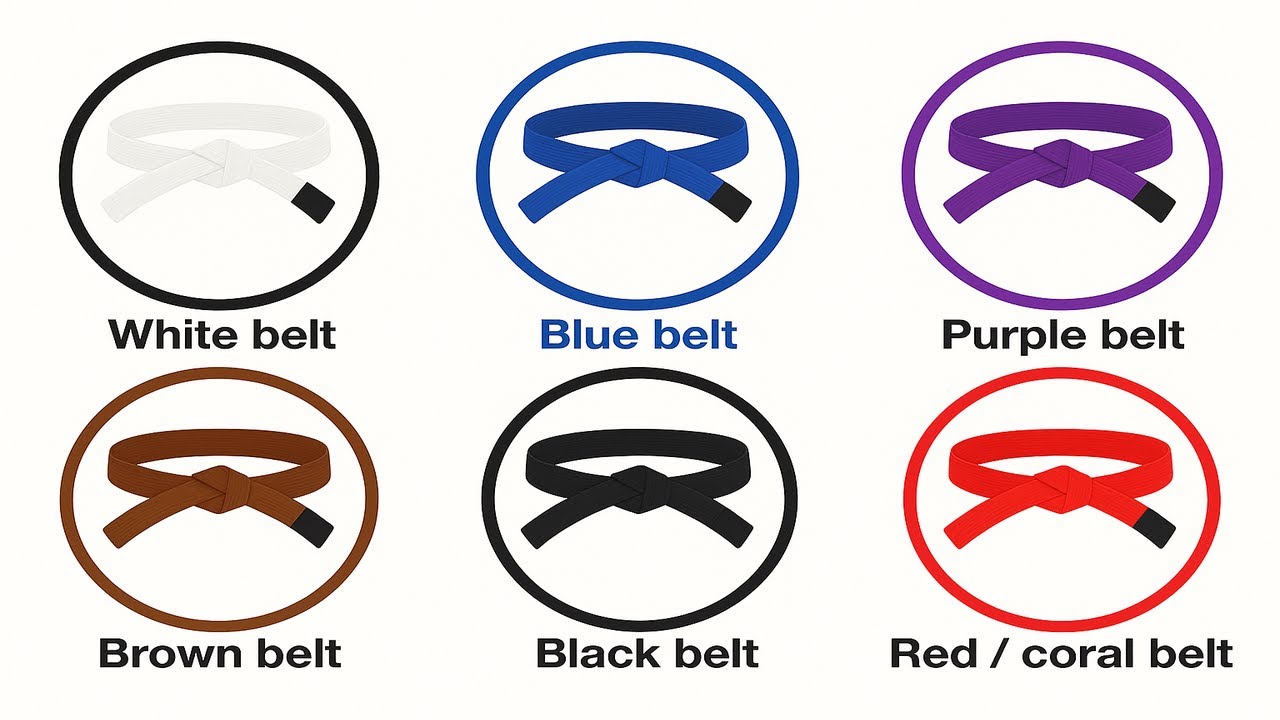
Black belt and beyond
Black belt is a major milestone, but it is not the finish line. In good academies, it means the student has spent years developing technical depth, composure, consistency, and the ability to apply jiu jitsu against resistance. It also means they carry responsibility. Other students watch how a black belt trains, teaches, and handles adversity.
Beyond black belt, there are degrees and later senior ranks. For a beginner, those ranks are background information. What matters now is understanding that the adult belt system is built for long-term growth. One step leads to the next, and the quality of your instruction shapes how solid each step becomes.
| Belt | What it usually means |
|---|---|
| White | Learning movement, defense, posture, and survival |
| Blue | Building reliable fundamentals and basic offense |
| Purple | Developing a personal style and stronger transitions |
| Brown | Refining details, sharpening timing, helping others |
| Black | Advanced understanding, leadership, and lifelong study |
Understanding Stripes The Mile Markers of Your Progress

A lot of beginners fixate on belt colors and miss the smaller signals of progress happening between them. That's where stripes come in.
A stripe is a mini-promotion placed on the belt to recognize development within that rank. It tells a student, "Your work is showing." That matters because a full belt promotion can take a long time, especially in BJJ.
Why stripes help beginners
The simplest way to think about stripes is mile markers on a long road. You may not be at the next town yet, but you can still see that you've moved forward.
Stripes help in a few ways:
- They reward consistency. Showing up regularly, paying attention, and improving your movement count.
- They make progress visible. A beginner often feels clumsy long after they have improved.
- They reduce frustration. When the next belt feels far away, a stripe reminds you that growth doesn't happen all at once.
- They prepare you for promotion. In many academies, stripes show that key habits and skills are developing before a full rank change.
Progress in BJJ rarely feels dramatic from the inside. Stripes give students a way to see what their coach already sees.
What stripes don't mean
Stripes aren't a stopwatch. They don't merely mean you attended a certain number of classes and automatically leveled up. Good instructors look at how you're moving, how you're thinking, and how you're training with others.
They also aren't meant to create anxiety. Some students compare stripe counts with everyone around them. That's usually a mistake. One person may train more often. Another may be working through injuries. Another may take longer to absorb concepts but become very solid later.
At academies influenced by the Caio Terra approach, the emphasis is usually on clean technique, strong fundamentals, and details that hold up under pressure. That's why stripes should feel like meaningful feedback, not random tape added to a belt.
The BJJ Belt System for Kids and Teens in Long Island

Parents in Lindenhurst and nearby towns often notice something right away. The kids' belts don't look the same as the adult belts.
That's intentional.
Children and teens usually move through a broader color system that includes ranks such as grey, yellow, orange, and green before they transition fully into the adult path. The extra colors create more frequent opportunities for recognition, which helps younger students stay engaged in a long-term skill-building process.
Why kids have more belt colors
Adults can usually tolerate delayed rewards better. A child often needs shorter feedback cycles to stay motivated and confident.
A strong kids' BJJ program uses belts and stripes to reinforce more than technique. It also rewards focus, listening, respect, self-control, and safe training habits. For a parent, that's a big part of the value.
Here is the basic logic behind the youth system:
- Grey belt often reflects early foundations. A child is learning movement, basic positions, and classroom structure.
- Yellow belt usually shows stronger understanding of core techniques and better control.
- Orange belt often points to growing tactical awareness and more confidence under pressure.
- Green belt can reflect advanced youth development and readiness for the demands of the adult system later on.
For a closer look at that progression, parents can review this page on the kids Jiu Jitsu belt system.
What parents should look for in a Long Island program
Not every kids' martial arts class uses the belt system well. Some schools hand out promotions so often that the rank loses meaning. Others wait so long that children stop feeling momentum.
A balanced academy does three things well:
- It keeps standards clear so belts still mean something.
- It teaches in age-appropriate steps so kids can succeed.
- It builds confidence without inflating ego so students grow in a healthy way.
For children, a belt should feel earned, understandable, and encouraging.
For families around Lindenhurst, North Babylon, West Babylon, and Copiague, that structure matters as much as the techniques themselves. A well-run youth belt system gives kids a visible path, and visible paths help young students stay with the process.
How You Earn Your Next BJJ Belt
A new student in Lindenhurst often walks in with the same question on day one. "How long does it take to get promoted?" It is a fair question, but it points to only one part of the answer.
Belts in Brazilian Jiu Jitsu are earned through a pattern your coach can see over time. Hours on the mat matter, but the true measure is whether your skill holds up when training gets live, messy, and uncomfortable. A belt works a lot like a report card mixed with a character reference. It reflects what you can do, how well you understand it, and how you carry yourself in the room.
What instructors actually evaluate
An instructor is usually watching several layers of progress at once:
- Technical understanding. You know the positions, escapes, controls, and submissions that fit your current rank.
- Performance in live rounds. You can apply those skills against a resisting partner, not just during drills.
- Decision-making under pressure. You stay composed, protect yourself, and choose sensible reactions.
- Training habits. You show respect, listen to coaching, and take care of your partners.
- Consistency. You keep showing up and building steadily instead of disappearing for long stretches.
Consistency deserves extra attention because BJJ is learned like a language. If you practice once in a while, you keep re-learning the same words. If you train regularly, the movements start to connect. Escapes lead to guard retention. Guard retention leads to sweeps. Sweeps lead to control. That chain is what coaches want to see.
Why the teaching environment affects promotion
Good instruction shapes how quickly a student makes sense of the art. Beginners rarely struggle because one technique is too advanced. They struggle because everything feels unfamiliar at once. Grips, balance, timing, pressure, etiquette, pacing. It can feel like trying to solve a puzzle while someone keeps changing the pieces.
A strong academy removes that confusion in the right order. Students learn the foundations first, then build from there.
That means:
- teaching core positions before flashy variations
- giving beginners enough resistance to learn, without throwing them into chaos
- correcting small mistakes early, before they become habits
- making the room safe enough for questions
The Caio Terra approach is helpful here because it places a high value on precision. Small details matter. Where your elbow goes matters. Where your head goes matters. How your weight is placed matters. For a new student, that kind of instruction makes progress easier to understand because success stops feeling random.
At Korfhage BJJ | Caio Terra Academy Long Island, that matters in a very practical way for Lindenhurst students. You are not trying to piece together your belt journey from videos, guesswork, and mixed advice. You are learning inside a system with clear standards and a technical style shaped by world-champion principles.
Promotion also reflects trust
When a coach promotes someone, the message is larger than "you learned more moves."
It also means, "you represent this rank well."
That trust shows up differently at each level. A blue belt should be able to train with newer students without turning every round into a survival test. A purple belt should show sharper control and better judgment. A brown belt should bring steadiness to the room. By black belt, people expect both knowledge and responsibility.
That is why promotions in good BJJ schools feel meaningful. They are not handed out to keep students entertained. They mark real development, seen over time, in a real training room.
For someone starting in Lindenhurst, that is good news. Your next belt does not depend on being naturally gifted or already athletic. It depends on patient instruction, steady attendance, honest effort, and a coach who knows what progress should look like at each step.
The BJJ Black Belt A New Beginning Not an End
A black belt in BJJ carries weight because it is uncommon. Estimates suggest only about 1 to 3% of all practitioners ever achieve it, and with a possible global participation range in the millions, the total number of black belts remains relatively small, as summarized in these Brazilian Jiu Jitsu black belt statistics.
That rarity is one reason people treat the rank as a major life milestone. It usually reflects more than a decade of dedication, setbacks, repetitions, injuries, learning, and returning.
What black belt really means
New students sometimes imagine black belt as the finish line. In practice, it's more like entering a new phase of responsibility.
A black belt is expected to understand the art thoroughly, teach responsibly, and keep learning. That's why experienced practitioners often say the black belt is the beginning of serious study, not the end of it.
The belts above black belt reinforce that idea. Degrees recognize continued time and contribution. Coral and red belts honor decades of involvement in the art. The whole system points in one direction. Lifelong development.
Why Caio Terra is a useful example
The author's brief specifically points to Caio Terra, a 12-time IBJJF World Champion and his approach to Jiu Jitsu. He stands as an example of how high-level BJJ is built on precision, discipline, and constant refinement. For a beginner, that matters more than flashy technique collections.
The lesson isn't that every student needs to become a world champion. The lesson is that real mastery stays curious. It sharpens details. It respects fundamentals. It keeps evolving.
A black belt in BJJ doesn't say, "I'm done." It says, "I've earned the responsibility to keep growing."
BJJ Belt FAQs and Starting Your Journey in Lindenhurst

When people ask about Brazilian Jiu Jitsu belts, they usually aren't only asking about rank. They're also asking practical beginner questions. That's smart. Small details help the first week feel less intimidating.
Common beginner questions
How do I tie my belt?
Most beginners need a few tries before it feels natural. The belt should sit flat, feel secure, and stay tied through class as well as possible. This step-by-step guide on how to tie a BJJ belt can help before your first session.
How often should I wash my belt and gi?
Wash your gi after every class. Most students also wash their belt regularly as part of good hygiene. Clean gear protects your training partners and keeps the academy environment healthier.
What happens to my rank if I switch schools?
In BJJ, your earned rank normally stays with you. A new instructor may take time to learn your game and understand your habits before considering future promotions, but your belt doesn't reset because you changed academies.
What to expect as a new student
A first class usually includes a warm-up, technical instruction, drilling with a partner, and beginner-appropriate live practice. You don't need to "win" class. You need to listen, move, and ask questions when you're unsure.
If you're coming from Lindenhurst, West Babylon, Copiague, North Babylon, or nearby parts of Long Island, starting close to home makes consistency easier. That's a bigger advantage than people think. When training fits your schedule, you're more likely to keep going through the slow early stages where real habits form.
Here are the basics that help new students settle in fast:
- Arrive a little early so you can meet the coach, get oriented, and avoid rushing.
- Expect to feel unfamiliar at first because BJJ has its own language and positions.
- Focus on one lesson at a time instead of trying to understand everything in a single class.
- Assess progress by better posture, calmer reactions, and improved defense, not just by taps or belt talk.
Starting BJJ doesn't require you to already look athletic or know what every belt means. It requires curiosity, patience, and a place where you can learn safely.
If you're ready to try Brazilian Jiu Jitsu in a structured, welcoming setting, Korfhage BJJ | Caio Terra Academy Long Island offers a $99 unlimited classes trial at its Lindenhurst location. For adults, kids, and families in Lindenhurst and nearby Long Island towns, it's a simple way to experience the training, meet the coaches, and begin your own belt journey with real guidance.