

If you're a parent in Lindenhurst, Babylon, Copiague, or West Babylon, you probably know the feeling. Your child is a good kid, but maybe they shut down when another child gets pushy, freeze in unfamiliar situations, or need something that builds real confidence instead of fake bravado.
That's why so many families start looking at self defense classes for kids. They're not just thinking about danger. They want their child to stand taller, listen better, stay calm under pressure, and learn how to deal with physical contact without panicking.
I'll give you my blunt opinion as a BJJ instructor and parent. If your goal is actual self-defense, not just activity for activity's sake, Brazilian Jiu-Jitsu is the right choice. And if you live within about 10 miles of Lindenhurst, you should judge schools with a sharper eye than most parents do.
A Parent's Guide to Building Confident Kids in Lindenhurst
A lot of Long Island parents start in the same place. Their child doesn't need to become a fighter. They need to stop shrinking when another kid gets rough at recess. They need to learn how to move with balance, speak with confidence, and handle stress without melting down.
That's why I don't like fear-based sales pitches around self defense classes for kids. Good training should build a child up. It should make them harder to bully, yes, but also more composed at school, more coachable, and more resilient when life gets uncomfortable.

Why parents are looking for more than a sport
In Lindenhurst and nearby towns, parents have plenty of options. Soccer, baseball, dance, wrestling, karate. However, the question isn't whether your child should do something. It's whether that something teaches calm under pressure.
Martial arts already has a real foothold with kids, which matters because it tells you this isn't some fringe idea. In the United States, about 1.8 million children ages 6 to 17 participated in martial arts in 2020, out of over 6.9 million total martial arts participants, according to industry reporting on martial arts participation.
Good kids' training doesn't create aggressive children. It gives nervous children a structure for becoming steady.
Confidence should look quiet
The best kind of confidence in a child is usually boring to watch. They make eye contact. They stop fidgeting when someone crowds them. They know how to say no. They don't overreact when a game gets physical. That's the kind of confidence parents in Lindenhurst should be paying for.
If you're also trying to keep your child engaged long term, it helps to think beyond discipline slogans. Motivation matters. A useful read on that side of the equation is Vanta Sports' youth athlete strategies, especially if your child starts strong and then loses interest when things get hard.
Here's the simple truth. The right self-defense program gives a child both character and coordination. The wrong one gives them a uniform, a belt chase, and very little that holds up when pressure shows up.
Why Brazilian Jiu-Jitsu is Most Effective for Kids
I'm not neutral on this. Brazilian Jiu-Jitsu is the most effective martial art for kids' self-defense.
Not for aesthetics. Not for popularity. It's because it reflects children's actual capabilities.
A smaller child is not going to win a striking match with a bigger, stronger, more aggressive person. That's fantasy. BJJ gives kids something more useful. It teaches base, balance, mechanical advantage, control, escapes, and composure when things get messy.
Why leverage beats power
BJJ is built around the idea that a smaller person can use positioning and mechanics to control space and protect themselves. For kids, that matters more than flashy kicks or point-scoring combinations.
When children train BJJ, they learn how to:
- Stay on their feet longer by improving balance and posture
- Break grips and create space instead of freezing
- Escape bad positions if someone grabs or tackles them
- Control movement without wild striking
- Stay calmer during physical pressure
That last point matters more than most parents realize. A child who panics usually forgets everything. A child who has practiced uncomfortable positions over and over is far more likely to respond with purpose.
Practical rule: For children, the best self-defense system is the one they can still use when they're scared, tired, and physically outmatched.
BJJ looks more like real conflict
Most playground incidents, roughhousing situations, and bullying-related physical confrontations don't look like movie fights. They involve grabbing, pushing, clinching, dragging, falling, and pinning. That's BJJ territory.
Striking arts have value. They can improve coordination, discipline, and body awareness. But if your child ends up in a scramble on the ground, a striking-heavy program leaves a major gap.
Here's the clean comparison.
| Attribute | Brazilian Jiu-Jitsu (BJJ) | Taekwondo | Karate |
|---|---|---|---|
| Main self-defense emphasis | Control, escapes, leverage, ground survival | Kicking range and striking patterns | Striking, forms, and stand-up defense |
| Works well for smaller kids | Yes, because it relies on positioning and mechanics | Less reliable when size gap is large | Better than no training, but still limited by power |
| Most realistic for grabs and takedowns | Strong | Limited | Limited |
| Problem-solving demand | High | Moderate | Moderate |
| Use under pressure | Strong when taught well | Depends heavily on timing and distance | Depends heavily on clean striking |
It's physical chess, and that's a good thing
Parents sometimes worry that grappling looks too complex. I see the opposite. BJJ teaches children to solve problems in sequence. If this happens, do that. If they turn, adjust here. If you lose position, recover. It's physical chess with consequences mild enough for learning and clear enough for a child to understand.
That problem-solving piece is one reason BJJ carries over outside the academy. Kids who learn to stay composed in a bad position often get better at dealing with frustration everywhere else too.
If you're shopping for self defense classes for kids around Lindenhurst, start with one question. Does this program teach a child what to do when someone bigger grabs them and refuses to let go? If the answer is fuzzy, move on.
The Caio Terra Method A Smarter Way for Kids to Learn
A child in Lindenhurst gets grabbed on the playground. The right training has to hold up in that moment, not just look organized during class. That's why the teaching method matters as much as the art itself.
Caio Terra built his jiu-jitsu around precision, timing, posture, and clean mechanics. For kids, that is the right foundation. They do not need to overpower anyone. They need to stay calm, move correctly, and apply simple actions that work against resistance.
Kids don't need more moves, they need better coaching
A weak kids program tries to impress parents with variety. A strong one builds skill in layers.
First, children learn how to base, stand, move, and protect themselves. Then they learn a small set of reliable positions and escapes. After that, they test those skills with controlled resistance, so the lesson becomes usable instead of theoretical.
That structure matters. Kids retain more when the class is organized, the cues are consistent, and each lesson connects to the one before it.

Why the Caio Terra approach fits children
The Caio Terra method gives kids a system. They learn why position comes first, why posture breaks down under pressure, and how timing beats panic. That makes a huge difference with children, especially smaller ones.
I recommend this approach because it produces kids who can adapt. A child who understands frames, balance, and connection does not freeze when a partner reacts differently. They make adjustments. That is real learning.
It also matches how children learn physical skills best. Good BJJ classes use repetition with purpose, guided problem-solving, and immediate feedback. This article on understanding experiential learning lines up well with that kind of coaching.
The right kids program builds judgment first, then technique, then confidence.
What parents in Lindenhurst should look for
If you're comparing academies around Lindenhurst, look past the words “kids martial arts” and ask how the program is taught. A Caio Terra school should be able to explain its progression clearly.
Look for these signs:
- Fundamentals come first, before flashy submissions or tournament tricks
- Position is taught before finish, so kids know how to stay safe and in control
- Live training is supervised carefully, with safety and body awareness treated seriously
- Concepts repeat across classes, so children build understanding instead of collecting random moves
If you want a better standard than generic marketing promises, read these modern jiu-jitsu training principles. That will give you a clear picture of what smart, technical instruction should look like in a local kids program.
Choosing the Right Instructor in the Lindenhurst Area
A bad instructor can ruin a good martial art. A great instructor can change a child's life.
That's not dramatic. It's the truth. Parents often spend more time comparing schedules and prices than they do evaluating the adult who'll be shaping their child's habits under stress. That's backward.
Age-appropriate teaching is not optional
One of the biggest gaps in online advice is that schools lump all children together. They shouldn't. A younger child needs awareness, simple boundaries, body control, and short attention-cycle teaching. An older child can handle more technical escapes, stronger resistance, and layered problem-solving.
That distinction matters, and it's been noted in guidance on age-appropriate self-defense instruction for children. A five-year-old and a twelve-year-old should not be taught the same way just because they're both in “kids martial arts.”

The checklist I'd use as a parent
When you visit schools in Lindenhurst, North Lindenhurst, West Babylon, Copiague, or Massapequa, look for these signals.
- Watch how the instructor corrects mistakes. Good coaches don't bark nonstop. They give clear, simple corrections and keep kids moving.
- Check whether discipline is calm or theatrical. You want structure, not intimidation.
- See if the room is controlled during partner work. If children are crashing into each other with no supervision, leave.
- Ask how classes are grouped. If the answer is vague, that's a problem.
- Look for lineage and curriculum standards. Affiliation can indicate a real system, not a grab bag of techniques.
What good teaching actually looks like
A strong kids' coach has range. They can manage a high-energy class without turning it into chaos. They can keep shy kids involved without embarrassing them. They can slow down the class when safety requires it, then bring the energy back up without losing the room.
You should also see technical clarity. If the instructor can't explain a movement clearly to a child, they probably don't understand it thoroughly themselves.
For parents comparing local options, these jiu-jitsu instructor standards are the kind of baseline I'd want to see. One local example is Korfhage BJJ | Caio Terra Academy Long Island, which teaches Brazilian Jiu-Jitsu in Lindenhurst with kids and beginner-focused instruction as part of its regular program lineup.
If the instructor can't balance safety, structure, and fun in the same class, keep looking.
What to Expect in Your Child's First BJJ Class
Your child walks onto the mat in Lindenhurst, looks around, and freezes for a second. That moment tells you a lot about the school. In a good kids BJJ class, the coach closes that gap fast, gives your child a clear spot, and gets them involved right away. The room should feel structured, calm, and active.

The first class should be simple. A smart instructor does not dump a pile of techniques on a new student. The Caio Terra approach is better for kids because it builds from position, posture, and repetition. Children learn what safe movement feels like before they are asked to solve bigger problems with resistance.
Warm-ups should have a reason. You want to see movements that connect directly to jiu-jitsu, such as shrimping, bridging, technical stand-ups, balance work, and basic partner drills. Those are not random exercises. They teach body control, awareness, and how to move safely on the ground, which is a big part of why parents see lasting benefits of martial arts for kids after training starts.
Here's a useful example of what a class environment can look like:
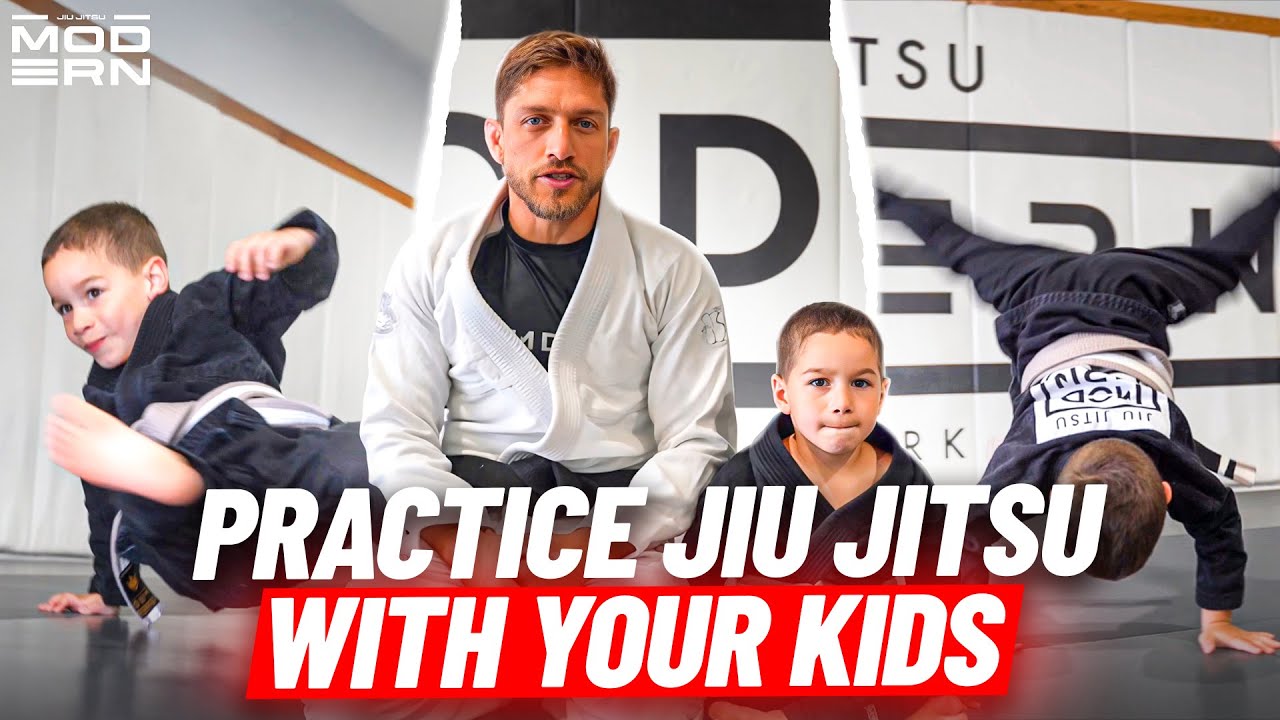
After that, expect one or two core techniques, not ten. Good kids instruction follows a sequence. First, the coach teaches base, posture, and how to get up safely. Then come simple escapes, grip awareness, and control positions. Live application comes later, once the child understands the shape of the movement.
In practical terms, your child may learn:
- How to fall and get up safely
- How to keep a strong base
- How to escape a simple hold
- How to control distance with frames and posture
That progression matters. It is one reason BJJ beats striking-based programs for children. A beginner can practice these skills with control, against resistance, without turning class into a kicking contest.
If the class includes rolling, it should look tight and supervised. For beginners, that usually means positional rounds or short games with clear limits. One child starts in guard. The other tries to pass. The coach watches closely and resets often. That is how kids learn timing and composure without chaos.
By the end of class, your child should know exactly what they worked on and what behavior mattered in the room. A solid school in Lindenhurst sends kids off the mat with a quick recap, a bow or handshake, and one clear lesson about effort, respect, or self-control. That first day should leave them a little tired, more confident, and ready to come back.
The Lifelong Benefits Beyond Self Defense
Parents often come in asking for self-defense. They stay because of everything else.
BJJ does improve body control, coordination, and fitness. But the longer-term value usually shows up in behavior, mindset, and how a child handles setbacks.
What the research supports
A major global review looked at 16 original studies published between 2005 and 2020, covering 1,615 participants ages 4 to 13 across 8 karate studies, 4 judo studies, 2 aikido studies, and 2 taekwondo studies. That review found benefits beyond physical conditioning, including improved social skills, self-confidence, and reduced aggressiveness, according to the review of martial arts in children.
That matters because good training for kids isn't just about teaching responses to danger. It's about shaping how they carry themselves every day.

The benefits I see on the mat
The kids who stick with BJJ usually change in predictable ways.
- They become harder to rattle. Getting stuck under pressure in class teaches composure.
- They learn honest confidence. Not fake swagger. Real confidence built from repeated effort.
- They get more respectful. You can't train well without learning cooperation and restraint.
- They become better problem-solvers. BJJ rewards adjustment, not panic.
Why this carries into school and home
Children in BJJ fail a lot in small, manageable doses. They lose position. They miss the move. A smaller training partner surprises them. Then they reset and try again.
That cycle is healthy. It teaches resilience without lectures. It teaches humility without humiliation. And it gives kids a place to earn progress instead of being handed praise for showing up.
If you want a local look at how martial arts can support development more broadly, this overview of benefits of martial arts for kids is worth reading.
The child who learns to stay calm on the mat usually gets better at staying calm off it too.
Start Your Child's Journey at Korfhage BJJ in Lindenhurst
If you want the short version, here it is. For self defense classes for kids, BJJ is the strongest option because it teaches effective body mechanics, control, escapes, and composure under pressure. The school matters. The instructor matters more. And the teaching method matters most when the student is a child.
For families in Lindenhurst and nearby towns, the smart move is to visit a local academy and watch a class before you commit. Look at how the coach speaks to children. Look at how the room is managed. Look at whether the curriculum is structured or random.
If you want a direct local option, Korfhage BJJ | Caio Terra Academy Long Island has been in Lindenhurst since 2007, is located at 99 W. Hoffman Ave, and offers a $99 unlimited classes trial for new students. That gives parents a low-pressure way to see whether the environment, coaching, and curriculum fit their child.
If you're ready to get your child into a structured, technical, and beginner-friendly program, take a look at Korfhage BJJ | Caio Terra Academy Long Island. If you live in Lindenhurst, Babylon, Copiague, West Babylon, or nearby, a trial class is the fastest way to see whether BJJ is the right fit for your child.