

A lot of people in Lindenhurst and the surrounding South Shore towns start in the same place. They want the fitness, self-defense, and confidence that martial arts can build, but they don't want to walk into a room full of experienced students and feel lost on day one.
That hesitation is normal. It's also fixable.
Mixed martial arts training at home works well when you treat it as preparation, not fantasy. You are not trying to become a complete fighter in your living room. You are building posture, movement, discipline, conditioning, and enough technical awareness to make your first real classes far more productive.
For most adults, that first win is mental. The mental benefits of martial arts are well-documented; practitioners consistently show superior self-control, reduced impulsivity, and higher creativity scores compared to sedentary peers, as discussed in this review of martial arts and psychological outcomes. That matters because the first barrier isn't talent. It's consistency.
Your First Step into Martial Arts in Lindenhurst
A common scenario looks like this. Someone from Lindenhurst, West Babylon, Copiague, or North Babylon spends weeks thinking about training. They watch matches, save videos, maybe buy gloves too early, then stall because they think they need to be in shape before they start.
You don't.
What you need is a clear first step and a realistic standard. At-home practice gives you both. It lets you build rhythm without the pressure of keeping up with a live room. You can learn how to stand, move your hips, get up from the floor properly, and hold a training schedule before another person ever puts hands on you.
What home practice should do for you
The best home training has a narrow purpose. It should help you:
- Build consistency: A short routine done regularly beats random hard workouts.
- Learn core movement: Hip escapes, bridges, technical stand-ups, and stance work transfer directly to mat time.
- Reduce first-day stress: You won't feel like every motion is brand new.
- Develop patience: Martial arts rewards repetition more than hype.
That last point lines up with the technical style many great jiu-jitsu coaches favor. Caio Terra's approach is known for precision, efficiency, and fundamentals that scale from beginner to advanced levels. That's the right mindset for home work too. Don't chase flashy combinations. Chase clean reps.
Start where you are, but start with structure.
A beginner in Lindenhurst doesn't need a perfect home gym. A small patch of floor, a timer, and enough room to lie down, turn, and stand up is plenty. If you can clear space beside a couch or at the foot of your bed, you can begin.
The right goal for your first few weeks
The goal isn't to prove toughness. The goal is to become coachable.
If you spend a few weeks building movement quality at home, live instruction starts making more sense immediately. Terms like base, frames, posture, hip movement, and balance won't sound abstract. You'll feel them. If you're still deciding how to begin, this guide on how to start Brazilian Jiu-Jitsu gives a useful picture of what that entry point can look like.
People often wait because they think confidence comes first. In martial arts, confidence usually comes second. The first step is practice.
Why Your Foundation Must Be Brazilian Jiu-Jitsu
If your goal is real self-defense and smart MMA development, Brazilian Jiu-Jitsu should be the center of your home training. Not because striking doesn't matter. It does. But BJJ gives you a way to control a person without depending on speed, knockout power, or athletic superiority.

A smaller, older, or less explosive person can still use mechanical advantage, angle, posture, and positional control. That's the key distinction. BJJ gives ordinary adults practical tools for bad positions, close-range clinches, takedowns, scrambles, and ground control. Those situations are chaotic. Technique matters more there than people think.
Why BJJ fits home preparation so well
Home training has limits. You can't pressure-test timing alone. You can't learn to read another person's resistance by shadow grappling. But you can build the movement language of jiu-jitsu extremely well at home.
That includes:
- Hip mobility: Most BJJ escapes and transitions start from the hips.
- Base and balance: Staying stable while moving is a trainable skill.
- Defensive reactions: Framing, turning, posting, and standing safely can all be drilled solo.
- Technical discipline: BJJ rewards details. Home drills are a good place to slow down and feel those details.
The Caio Terra influence matters. His style is often associated with technical sharpness over brute force. That philosophy helps beginners because it keeps them focused on mechanics instead of ego. If your home training is BJJ-centered, you learn to solve problems with position first.
Why not build around striking first
Striking is important in mixed martial arts training at home, but beginners often misuse it. They hit the air hard, throw sloppy combinations, over-rotate, and confuse exhaustion with progress. It feels productive because it looks dynamic.
BJJ fundamentals are less glamorous and more durable.
They teach you how to move your body under pressure, how to stay calm in bad spots, and how to use structure instead of panic. That transfers to MMA better than random shadowboxing sessions with no coaching context.
Practical rule: Build your martial arts around what gives you control, not what only gives you activity.
There's also a safety argument. While MMA seems high-risk, 78% of injuries occur during training, not competition, according to this overview of martial arts injury patterns and benefits. That's one reason controlled, technique-focused work matters so much. BJJ, taught correctly, gives people a path to train intelligently through mechanical advantage and positional awareness rather than uncontrolled impact.
What BJJ teaches that home fitness can't
A generic workout can make you tired. It can't teach you these habits:
| Skill | Why it matters |
|---|---|
| Positional awareness | You learn where you are, not just what you're doing |
| Energy management | Good grapplers don't waste movement |
| Pressure tolerance | You learn to stay organized in uncomfortable spots |
| Problem solving | Every position has answers, if your mechanics are sound |
That's why BJJ is the best base for someone in Lindenhurst who wants practical skill, not just another workout plan. Strength helps. Cardio helps. But if your foundation is weak, everything you add on top of it is less useful.
The Solo Grappling Blueprint BJJ Drills You Can Do Today
The fastest way to make home training useful is to drill the movements that show up in almost every beginner class. These aren't random calisthenics. They are the building blocks of how a grappler escapes, recovers, stands, turns, and reconnects to a stable base.

Shrimping and hip escapes
If I had to choose one movement for a brand-new student to own at home, it would be the shrimp. In BJJ, your hips are your steering wheel. If they don't move well, your escapes won't work.
How to do it
- Lie on your back with knees bent.
- Turn slightly onto one side.
- Push off the foot on the same side and slide your hips backward.
- Keep your top knee and elbows engaged as if you're making space from an opponent.
- Reset and repeat on both sides.
The point is not speed. The point is distance. You're teaching your body how to create space when someone is trying to pin you.
Why it matters
A proper hip escape shows up in side control escapes, guard recovery, and general defensive movement. It also teaches beginners not to stay flat.
Bridging and turning
A lot of beginners try to solve pressure by pushing with their arms. That's weak mechanics. Bridging teaches you to use your whole body.
How to do it
- Lie on your back with feet close to your hips.
- Drive through your feet.
- Lift your hips high.
- Turn over one shoulder, not straight backward.
- Return under control.
Think about sending force diagonally, not just upward. That detail matters because real escapes happen at angles.
Technical stand-up
The technical stand-up is one of the cleanest examples of BJJ's practicality. It teaches you how to get off the floor while protecting yourself.
How to do it
- Sit with one hand posted behind you.
- Keep the opposite hand up as if protecting your face.
- Plant one foot near your body.
- Lift your hips off the floor.
- Slide the free leg underneath.
- Stand while staying balanced and ready to move.
A lot of people rush this drill. Don't. The value is in balance and posture. If you train this right, you stop standing with your head down and your base exposed.
This breakdown of the rear naked choke in MMA also helps frame why foundational body positioning matters so much. Even submissions begin with control and movement quality long before the finish.
A simple solo flow
Once the individual pieces start feeling natural, connect them. One good beginner flow is:
- Bridge
- Shrimp
- Recover seated base
- Technical stand-up
- Return to the floor with control
- Repeat on the other side
This teaches transitions, not just isolated movements.
Good solo grappling should feel like learning a language. Each movement should connect to the next.
Granby-style rolling and shoulder movement
Not every beginner needs aggressive inversions early. But some shoulder rolling and rotational movement is useful if your neck is healthy and you have enough space.
Keep it basic:
- Roll over one shoulder, not your neck.
- Stay rounded.
- Move slowly.
- Stop if you feel compression or disorientation.
The goal isn't to become fancy. It's to become comfortable rotating and recovering under motion.
A visual demo can help when you're trying to clean up movement patterns:
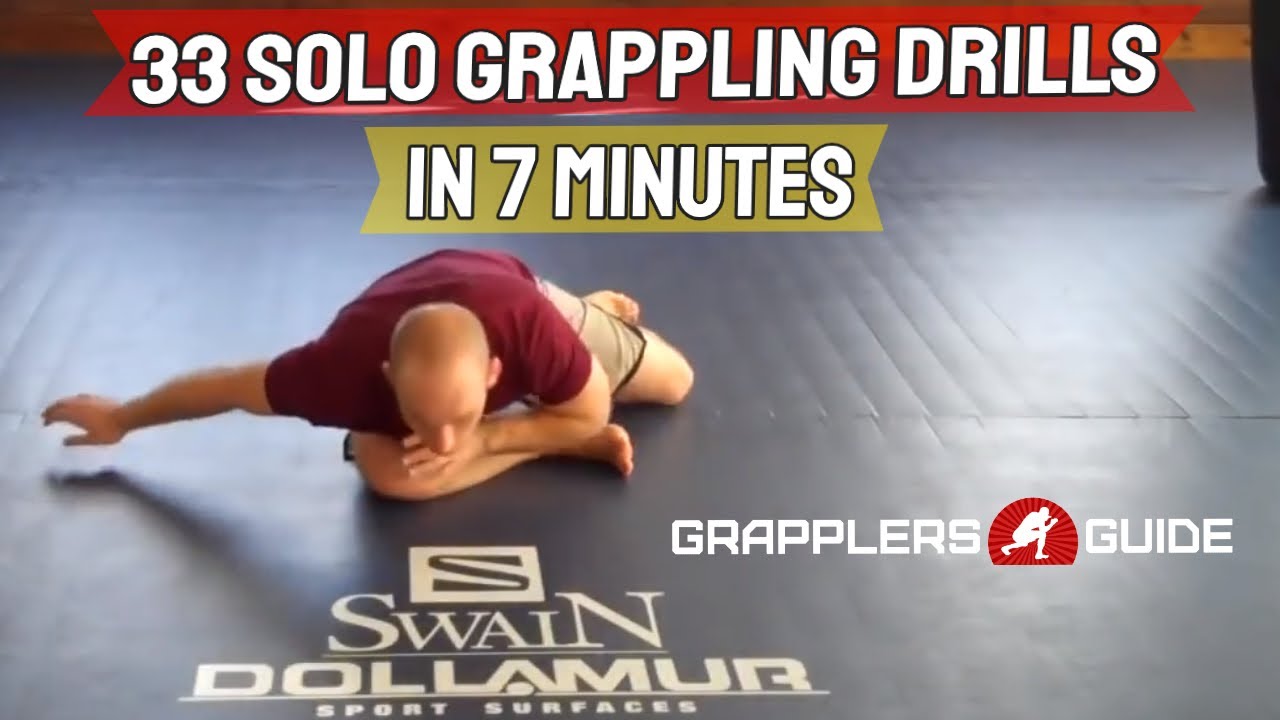
A beginner home drill session
Try this structure for one session:
| Drill | Focus |
|---|---|
| Shrimping | Hip movement and space creation |
| Bridging | Power from the floor and turning angle |
| Technical stand-up | Safe return to standing |
| Seated guard movement | Base, posture, hand placement |
| Sprawls to base | Reaction and body control |
| Slow flow sequence | Linking movements together |
Common mistakes that slow progress
A lot of solo BJJ work fails for the same reasons:
- Rushing reps: Fast sloppy movement builds bad timing.
- Training flat-backed: If your hips and shoulders never engage, the drill loses value.
- Ignoring posture: Head position and elbow position matter even in solo work.
- Doing too many drills at once: A short list done well beats a long list done poorly.
If you're using mixed martial arts training at home to prepare for real classes, these drills are enough to start. You don't need ten fancy sequences. You need clean mechanics that a coach can sharpen once you're on the mats.
Building Striking and Conditioning with Minimal Gear
You clear a space in the living room, set a timer, and start throwing punches. Within a minute, one problem shows up. Without structure, home striking turns into flailing, and flailing does nothing for jiu-jitsu.
At Korfhage BJJ, I want beginners to treat home striking as support work for the academy, not as a substitute for coached rounds. The goal is simple. Build footwork, posture, breathing, and enough conditioning that your first classes in Lindenhurst feel manageable. That fits the Caio Terra approach well. Clean fundamentals first, then add speed and complexity later.
Shadow work that carries over to MMA
Good shadowboxing for a grappler is quiet and disciplined. Stance stays under you. Chin stays tucked. Hands return home. Hips and feet work together so you can strike, level change, and recover balance without crossing yourself up.
A useful format is 5 x 3-minute rounds with 1-minute rest. Keep each round focused. The shadow sparring methodology video gives a solid model for visualizing an opponent instead of waving your arms through memorized combinations.
Use the rounds like this:
Round 1: Footwork
Step forward, back, left, and right. Add pivots. Stay in stance the whole round.Round 2: Basic hands
Jab, cross, hook, reset. Exhale on each punch. Finish every exchange in position to move.Round 3: Hands plus defense
Add slips, level changes, and sprawls. By doing so, striking starts connecting to MMA instead of boxing alone.Round 4: Entries and exits
Step in behind the jab, angle off, reset, then re-enter. Beginners often forget the exit. That habit gets punished fast in live training.Round 5: Scenario round
Work one simple situation for the full round. Opponent pressures forward. You frame, circle, jab, and get out. Or opponent retreats. You close distance under control.
One clean round beats five sloppy ones.
Conditioning that helps your grappling
Home conditioning should build repeatable effort. BJJ punishes athletes who only know how to sprint and crash. You need to work, recover, and work again without your posture falling apart.
If you have one kettlebell or dumbbell, keep the menu short. Goblet squats, rows, presses, reverse lunges, carries, and dead bugs cover a lot. If you have no equipment, bodyweight still gets the job done.
Start with this simple circuit:
- Pushups
- Bodyweight squats
- Split squats
- Burpees
- Glute bridges
- Planks and side planks
- Mountain climbers
Run them in rounds with fixed work and rest periods. Keep the pace honest enough to raise your heart rate, but controlled enough that positions stay sharp. If your pushups turn into worming off the floor and your squats lose depth, the round went past useful work.
Better choices for BJJ-focused conditioning
The trade-off at home is clear. Exhaustion feels productive, but quality wins more often than fatigue.
| Priority | Better choice | Worse choice |
|---|---|---|
| Core endurance | Planks, hollow holds, leg lifts, carries | High-rep crunches with bad neck position |
| Hip drive | Bridges, squats, sprawls, step-ups | Random jump reps with no landing control |
| Upper-body stamina | Pushups, rows, wall walks | Testing max strength every week |
| Recovery between efforts | Timed intervals with nasal breathing on rest | Going to failure on every set |
For beginners preparing to join a serious academy, that matters. I would rather see a student come into Korfhage BJJ with solid movement, decent lungs, and discipline than with a pile of bad habits from unsupervised hard rounds.
If you are also cleaning up recovery outside training, this guide to optimizing athletic performance gives useful context on nutrition and supplements without pretending they replace sleep, coaching, or mat time.
Mistakes that waste home training time
Three errors show up constantly.
Throwing hard into the air
Power without a target or coach usually leads to overreaching, poor balance, and sore joints.Adding complex combinations too early
Beginners do better with jab-cross, hook-cross, and basic entry-exit patterns than with flashy six-strike sequences.Conditioning past technical failure
Once posture breaks, the round stops building skill and starts rehearsing bad mechanics.
Home work should leave you more coordinated, not just exhausted. Done right, striking and conditioning at home give you a better starting point when you step onto the mats with a qualified coach.
Your Weekly At-Home MMA Training Schedule
You get home from work, you have 35 minutes, and you want training that helps when you finally step into a real academy. That is where a weekly plan earns its keep. Without one, beginners usually cram too much into one session, skip two days, then start over.

At Korfhage BJJ, I want home practice to build habits that carry onto the mat. That means structure, repeatable drill choices, and enough recovery to keep movement sharp. Caio Terra's approach to jiu-jitsu has always reflected that idea. Details matter, and consistency beats random intensity.
If your goal is to prepare for serious training in Lindenhurst, follow a schedule that keeps BJJ at the center. For a broader look at that path, read our guide on how to get started with MMA training.
Beginner 4-Week At-Home Training Plan
| Day | Focus (Weeks 1-2) | Focus (Weeks 3-4) |
|---|---|---|
| Monday | BJJ solo drills, slow pace, movement quality | BJJ solo drills with linked flow sequences |
| Tuesday | Strength and conditioning, moderate effort | Strength and conditioning with fuller rounds |
| Wednesday | Striking footwork and basic combinations | Striking rounds with visualization and defensive layers |
| Thursday | Active recovery and mobility | Active recovery plus technical review |
| Friday | BJJ fundamentals, repeated key drills | Longer BJJ drill chains and stand-up entries |
| Saturday | Mixed conditioning and light shadow work | Mixed session with cleaner transitions |
| Sunday | Rest and mental review | Rest and mental review |
How to use the week correctly
Keep two ideas in mind. BJJ comes first, and fatigue should not ruin your mechanics.
A practical week looks like this:
Monday
Work shrimping, bridging, technical stand-ups, hip switches, and seated movement. Stay slow enough to feel each position.Tuesday
Run a simple circuit for rounds. Pick a few reliable movements such as squats, pushups, sprawls, step-ups, and planks, then repeat them at a pace you can hold with good posture.Wednesday
Use striking for footwork, stance recovery, straight punches, and clean exits. The goal is balance and coordination, not wild volume.Thursday
Do mobility, light stretching, walking, and easy floor movement. If soreness starts building, this guide on preventing post-workout muscle soreness is useful because it focuses on recovery habits that help people stay consistent.Friday
Return to BJJ movement and connect drills into short chains. For example, bridge to elbow escape, technical stand-up, then level change back to the floor.Saturday
Mix short shadow rounds with bodyweight conditioning. Keep the pace honest, but leave a little in the tank.Sunday
Rest fully or review video and rehearse movements at low speed.
That rhythm works because it spreads stress across the week. You get enough practice to improve, but not so much fatigue that every session turns sloppy. For beginners, that trade-off matters more than trying to feel crushed after every workout.
Adjustments for age and fitness level
Older adults, busy parents, and deconditioned beginners usually do better by lowering impact, not by dropping training days. Keep the habit. Trim the wear and tear.
Use changes like these:
- Swap burpees for squat-to-stands
- Use chair-supported balance work
- Reduce pace before reducing technical practice
- Prioritize floor mobility and technical stand-ups
- End sets while form is still clean
I would rather see someone complete four controlled weeks than one hard week followed by knee pain, sore shoulders, and missed sessions. Home training should make you more prepared for coached classes at Korfhage BJJ, not less.
When to Join a Gym The Final Step to Real Skill
Home practice has a ceiling. It's a valuable ceiling, but it's still a ceiling.
You can improve movement, conditioning, discipline, and technical familiarity alone. You cannot learn timing under pressure, adapt to resistance, or fix subtle mistakes fast enough without real coaching. That's where many self-taught martial artists stall. They become good at rehearsing what they already believe is correct.

What an instructor changes
A good instructor gives you three things home training can't:
| Need | What coaching provides |
|---|---|
| Feedback | Immediate correction before bad habits harden |
| Resistance | A real partner changes timing, pressure, and decision-making |
| Progression | The right next step, instead of random online content |
This matters even more in BJJ. The art is technical. A small grip change, angle change, or weight shift can completely change whether a movement works.
Caio Terra's influence on jiu-jitsu instruction is a strong reminder of that. High-level jiu-jitsu isn't built on vague effort. It's built on precise mechanics taught by someone who understands how details connect.
Who should make the jump sooner
Some people should move from home work to in-person instruction quickly:
- Adults who want real self-defense
- Beginners who feel stuck repeating drills
- People with past injuries who need supervision
- Older adults who need lower-impact structure
- Anyone serious about MMA beyond fitness
That last group especially needs coaching. If you want to understand when home preparation ends and real development begins, this article on how to get into MMA lays out the bigger picture.
Generic high-intensity home workouts often neglect older adults. The success of BJJ-focused home programs for seniors comes from low-impact drills that utilize efficient body mechanics, but supervised instruction remains the safest way to learn proper movement and technique, as discussed in this overview of at-home MMA workouts and senior-friendly training gaps.
A realistic timeline
If you've followed a solid home plan for a few weeks, you're in a good spot to step onto the mats. Not because you've mastered anything. Because you've removed the chaos from day one.
You'll know how to get up. You'll know how to move your hips. You'll know how to pace a round. You'll understand that technique beats panic. That's a strong starting point for residents of Lindenhurst, Babylon, Copiague, Amityville, West Babylon, and nearby towns who want real instruction without wasting their first month figuring out what their body is doing.
Solo training builds readiness. Live training builds skill.
If you're ready to turn home practice into real progress, Korfhage BJJ | Caio Terra Academy Long Island offers a beginner-friendly path for adults, kids, seniors, and anyone in the Lindenhurst area who wants technical instruction rooted in Brazilian Jiu-Jitsu. The academy has served Long Island since 2007 and offers a $99 unlimited classes trial, which gives you a practical way to test the difference between solo preparation and coached training on the mats.