

If you're in Lindenhurst, Babylon, Copiague, West Islip, or anywhere nearby, there's a good chance you're looking for something practical. You want to get fitter, feel harder to intimidate, and learn a skill that holds up under pressure. You also don't want to spend months on flashy techniques that fall apart the moment someone bigger grabs hold of you.
That's where Brazilian Jiu-Jitsu stands apart. It teaches control first, then escape, then pressure, then finishes. When people ask about submission techniques, they usually want to know which choke or joint lock to learn first. The better question is whether they're learning those techniques from someone who teaches them with structure, safety, and real-world judgment.
Why Brazilian Jiu-Jitsu Is Your Best Choice for Self-Defense
A lot of adults on Long Island start martial arts for the same reason. They want confidence without becoming reckless. They want a training method that works for a parent in Lindenhurst, a commuter from West Babylon, a college student in Amityville, or a professional in Deer Park who needs stress relief and practical self-defense in the same place.
Brazilian Jiu-Jitsu is the strongest answer because it gives ordinary people a repeatable way to control a resisting person through mechanical advantage, positioning, and timing instead of striking power. That matters in real life. In reality, the focus isn't on winning a highlight reel exchange. They need to stay safe, control distance, escape bad spots, and if necessary, apply a submission with precision.

Why instruction matters more than motivation
The hard truth is that enthusiasm isn't enough. Only 1–3% of all people who start BJJ earn a black belt, which underscores the necessity of disciplined, long-term instruction for mastery. This rarity means that finding a qualified instructor is essential for any practitioner aiming for significant progress according to this breakdown of black belt rarity in BJJ.
That matters for beginners in Lindenhurst because early habits become permanent habits. A good instructor won't just show you a rear naked choke and tell you to squeeze. They teach where your hips go, how your weight should feel, when to abandon a finish, and how to train without hurting your partner.
Practical rule: The right academy doesn't just teach you how to submit someone. It teaches you when control is enough.
The Caio Terra approach in a local setting
Caio Terra, a 12 time IBJJF world champion, built his jiu-jitsu reputation on technical precision, efficient movement, and disciplined fundamentals. That style fits beginners well because it doesn't depend on athleticism or size. It depends on details. For someone living within ten miles of Lindenhurst, that's important. You need coaching that makes BJJ understandable from day one, not mysterious.
If you're comparing options, it's worth reading about why BJJ is good for self-defense and then judging schools by how they teach. Look for a room where beginners learn posture, frames, escapes, and controlled submission techniques before they're pushed into intensity they can't manage.
A good academy gives you more than classes. It gives you a map. In BJJ, that's the difference between staying stuck at white belt and building a skill set you can trust under stress.
The Core Principles of Effective Submission Techniques
Beginners usually think submission techniques are about memorizing steps. They aren't. A submission works because several principles line up at the same time. If one piece is missing, the technique feels weak, the opponent moves, and you burn energy trying to force something that isn't there.

Position comes first
The Caio Terra philosophy starts with a simple truth. Position before submission. If you don't control the line of the shoulders, hips, or head, your finish is usually premature.
Think about mounting a larger opponent. If your knees are loose and your weight is high, your armbar setup will feel unstable. If your knees pinch, your hips settle, and their elbow line is trapped, the same technique suddenly feels almost effortless.
A beginner should learn to ask these questions before attacking:
- Where is my opponent's head? If the head is free, posture is usually still available.
- Who controls the hips? If they can turn and scoot, the finish is probably not ready.
- Can they see the attack coming? Visible attacks are easier to defend.
Leverage beats force
BJJ becomes accessible to adults of all sizes around Lindenhurst. You're not trying to overpower someone. You're trying to put your body in a structure that makes their strength matter less.
A proper kimura is a good example. It isn't a wild shoulder crank. It is wrist control, elbow separation, body pinning, and rotation applied in sequence. The same principle shows up in triangles, guillotines, and armbars. Mechanics create pressure. Muscling the finish usually creates space.
Smaller students make fast progress when they stop trying to "win the squeeze" and start learning where to place their hips, knees, and grips.
Control, pressure, and timing
These three often get lumped together, but they are different.
| Principle | What it means on the mat | What beginners usually do wrong |
|---|---|---|
| Control | Limiting movement before the finish | Attacking while the opponent is still mobile |
| Pressure | Applying steady force without losing structure | Bursting too hard, then losing alignment |
| Timing | Attacking during transitions or reactions | Waiting until the opponent is fully set |
Brazilian Jiu-Jitsu also stays safer than many people expect because its foundation is control, not impact. Brazilian Jiu-Jitsu demonstrates a verified injury rate of just 5.5 injuries per 1,000 hours of training, making it significantly safer than many other combat sports because its principles focus on control and mechanical advantage, not dangerous strikes based on this BJJ safety overview.
That matters for local adults with jobs, families, and responsibilities. You can train hard, learn serious submission techniques, and still build your progress around technical rounds instead of unnecessary damage.
Your First Five Submissions The Korfhage BJJ Way
A beginner doesn't need fifty submissions. A beginner needs a small group of dependable attacks that teach the right habits. These five do that. They appear in sport, self-defense, and daily academy training because they build control, awareness, and finishing mechanics.

Rear naked choke
If I could only give a new student one finishing skill, it would be this one. The Rear Naked Choke is historically the most successful submission in BJJ, accounting for approximately 30–40% of all finishes in major competitions, making it the most critical finishing technique for both sport and self-defense according to competition data on high-percentage BJJ submissions.
The reason is simple. Back control limits the defender's vision, turning, and hand fighting options.
Key teaching points:
- Secure back control first. Your legs matter as much as your arms.
- Hide the choking hand. If they can see and grab it early, you'll fight their defense instead of applying the choke.
- Finish with structure. Elbows close, chest connected, head tight.
For local students who want more detail on the mechanics, this page on the MMA rear naked choke is a useful technical reference.
A clean rear naked choke doesn't feel explosive. It feels inescapable.
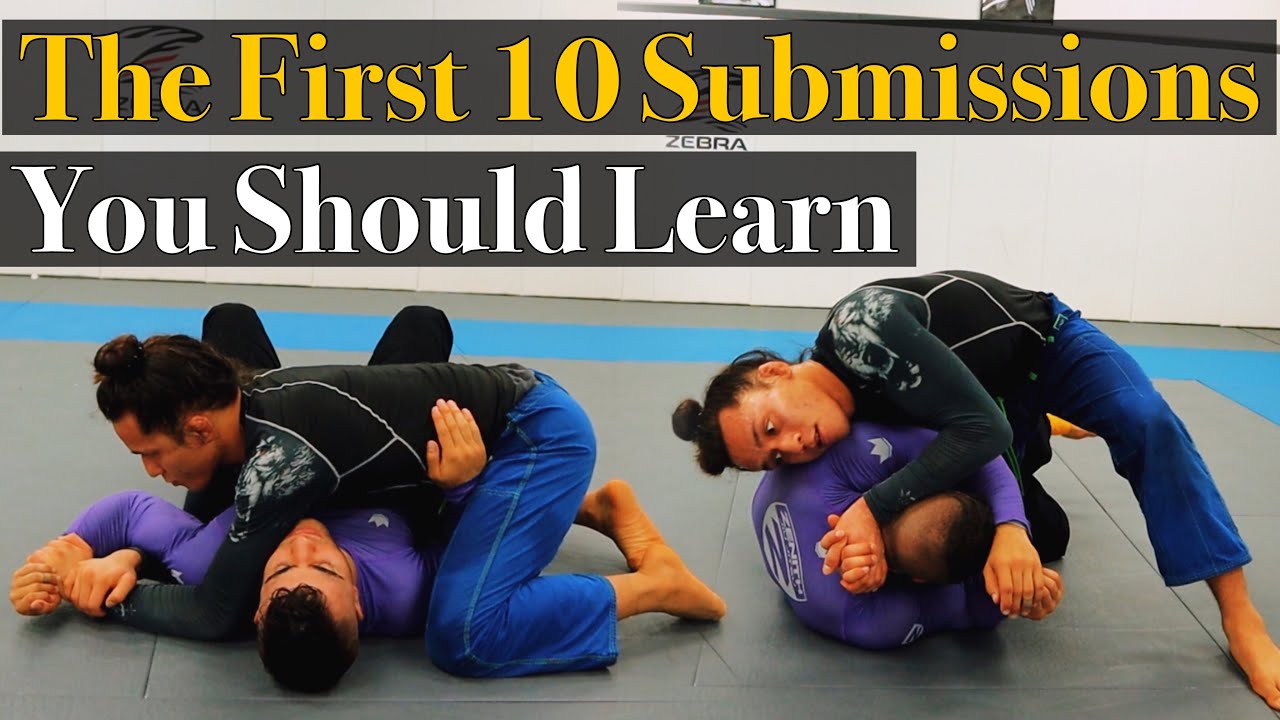
To see a high-level demonstration in action, watch this breakdown:
Triangle choke
The triangle teaches two lessons at once. You must break posture, and you must angle your body. Beginners often lock their legs too early and wonder why the choke feels weak.
What matters is this:
- Control the posture before the lock.
- Isolate one arm in and one arm out.
- Cut an angle before squeezing.
The triangle is one of the clearest examples of BJJ rewarding patience. If your opponent is still tall, your legs aren't failing. Your setup is.
Armbar
The armbar shows whether a student understands control through the hips. Most beginners think the finish happens with the hands. It doesn't. The finish comes from leg position, heel pull, knee pinch, and the opponent's thumb line being exposed correctly.
Three details make a huge difference:
- Pin the shoulder line. If the shoulder turns, the arm escapes.
- Keep the knees active. Loose legs create defensive space.
- Lift the hips only after the limb is isolated.
If you want to expand from basic armbars into related upper-body attacks, a good next study topic is learning the arm triangle choke, especially for understanding how head-and-arm control creates finishing pressure from dominant top positions.
Kimura
The kimura is one of the best teaching tools in BJJ because it works as a submission, a control position, and a transition hub. You can attack it from guard, side control, north-south, and scrambles.
A beginner should think of the kimura in layers:
| Layer | Focus |
|---|---|
| Grip | Wrist controlled, figure-four secured |
| Pin | Opponent's shoulder line and torso limited |
| Finish | Rotation only after the structure is trapped |
When the kimura is done well, you aren't chasing the hand around. You're stapling the upper body to the floor and taking away every easy escape.
Guillotine
The guillotine is common because people expose their neck when they shoot badly, wrestle up carelessly, or drive forward with poor head position. It can become a powerful beginner submission, but only if it's taught with restraint and detail.
Don't think "pull up on the neck." Think "fold the head into the chest while my body closes the space."
The guillotine works best when your chest, ribs, and choking arm all agree on the same direction. If your hands are doing one thing and your hips are doing another, the opponent will usually pop free.
Among local options for structured fundamentals, Korfhage BJJ | Caio Terra Academy Long Island teaches these core submission techniques inside a fundamentals-first curriculum, where beginners learn control and safe finishing mechanics before speed becomes a factor.
Common Mistakes and How to Fix Them
Most failed submission techniques don't fail because the move is wrong. They fail because the student tries to finish before earning the finish. That's normal early on, but it needs to be corrected quickly.

Mistake one: attacking without posture control
This is the biggest one. Over 60% of failed submission attempts occur because attackers neglect to break the opponent's posture simultaneously; breaking posture while applying a choke forces the opponent to solve two problems at once, dramatically increasing the success rate based on this explanation of BJJ submission mechanics.
In plain language, if your opponent can stay tall, turn in, or rebuild alignment, your submission is fighting uphill.
Fix it with a simple rule set:
- Control the head first when you're attacking chokes from guard.
- Pull with your legs, not just your arms when you need to collapse posture.
- Pause and check alignment before the finish.
Mistake two: rushing the finish
A rushed armbar usually loses the elbow line. A rushed triangle usually gets stacked. A rushed kimura usually turns into a scramble.
The correction is boring, and that's why it works. Slow down for one extra beat and confirm your checkpoints.
The tap comes from control built over several seconds, not from one sudden burst.
Mistake three: loose grips and disconnected limbs
A submission isn't just an attack. It's a trap. If one part of the body is free, the opponent uses it to create enough movement to survive.
Try this mental checklist when rolling:
- Hands connected: Are your grips active or just touching?
- Elbows tight: Is space opening between your arms and ribs?
- Knees engaged: Are your legs participating in the control?
Mistake four: refusing to move to the next attack
Beginners often treat a defended submission as failure. It isn't. It is information. If someone postures hard out of your triangle setup, that reaction often opens an armbar, a sweep, or a top position change.
A better habit is to expect resistance. The first attack creates the second.
For adults training around Lindenhurst, this mindset helps in both self-defense and regular class rounds. You stop panicking when something doesn't finish immediately. You start reading reactions, staying safe, and moving with purpose.
Submissions for Sport Competition vs Real-World Self-Defense
The same submission can serve two different goals depending on the situation. In a tournament, you're trying to control, score, and finish within a rule set. In self-defense, you're trying to stay upright if possible, manage distance, control the threat, and get home safely.
That doesn't make sport training less useful. It makes context important.
What changes in competition
In IBJJF-style competition, students learn to value position with precision. Back control, mount, side control, and guard passing create a path to submission techniques that can be repeated under pressure. That structure develops timing and discipline.
Caio Terra's approach fits this environment well because it is detail-oriented. A small adjustment in hip angle, grip line, or chest pressure changes whether a finish is available. Competition sharpens those details because your partner is trained, alert, and trying to deny every inch.
What changes in self-defense
On the street in Lindenhurst or a nearby town, the priorities narrow fast. You may not want to chase a low-percentage finish when disengagement is available. You may need to control from the clinch, get on top, pin the hips, or use a choke only when it is the safest route to stopping further harm.
That is one reason BJJ has earned so much trust in professional settings. Law enforcement data shows BJJ practitioners achieve a 52% reduction in officer injuries and a 67% decrease in suspect injuries, with 91% of successful physical resolutions occurring within 12 seconds, proving its real-world effectiveness according to this article on BJJ in street and professional use.
A practical comparison
| Setting | Main goal | Best mindset |
|---|---|---|
| Sport competition | Score, control, submit within rules | Build sequences and stay patient |
| Self-defense | Stay safe, control, escape if possible | Use the least force needed to end danger |
Good self-defense training doesn't make students reckless. It makes them calmer, harder to control, and better at making decisions under stress.
For Long Island residents, that distinction matters. You don't need fantasy scenarios. You need training that helps you stay composed when someone crowds your space, grabs hold, or forces a physical exchange you didn't ask for.
Start Your Path to Mastery in Lindenhurst
Learning submission techniques the right way takes time. That's not a downside. It's the reason the skill lasts. You build judgment along with mechanics, and that combination matters more than collecting moves.
For adults in Lindenhurst and the nearby communities, the biggest early win isn't submitting everyone in class. It's becoming harder to overwhelm. You learn how to frame, breathe, recover posture, protect your neck, control another person without panicking, and apply pressure without losing balance. Those are useful skills whether your goal is self-defense, fitness, competition, or proving to yourself that you can do something demanding.

What good progress actually looks like
It usually doesn't look dramatic. It looks like:
- Escaping more cleanly from bad positions instead of freezing.
- Holding top position longer without wasting energy.
- Recognizing openings sooner for chokes and joint locks.
- Training with control so your partners trust you.
That kind of progress is exactly what a fundamentals-driven room should produce. Caio Terra's method has always pointed students back to precision, patience, and efficiency. For beginners, that's ideal. For experienced students, it's what keeps the basics sharp enough to hold up against resistance.
Why local matters
A school close to home makes consistency possible. If you live within ten miles of Lindenhurst, regular training is much easier to sustain than a long commute across Long Island. And consistency is what changes BJJ from an interesting idea into a real ability.
If you've been searching for a martial art that improves fitness, sharpens confidence, and teaches practical self-defense without relying on brute force, BJJ is the right path. If you want that path to be safe and productive, the instructor and the teaching method matter just as much as the art itself.
Korfhage BJJ | Caio Terra Academy Long Island offers a $99 unlimited classes trial for people in Lindenhurst, Babylon, West Islip, Copiague, and nearby Long Island communities who want to start training with structure and purpose. If you're ready to learn submission techniques in a clean, beginner-friendly environment built around safety, body mechanics, and real instruction, this is the easiest way to get on the mat and see how BJJ fits your life.