

The mma rear naked choke is not just another submission. Over the last 25 years of UFC competition, it has accounted for nearly 40% of all submission finishes, with an all-time UFC submission share of 36.7%, making it the winning method in about 1 out of every 13 fights according to this UFC submission analysis.
That one fact changes how many individuals should think about grappling.
Beginners often assume the rear naked choke is just a strong squeeze. Experienced people know better. It is the cleanest example of what makes Brazilian Jiu-Jitsu so effective in MMA, self-defense, and genuine training for ordinary people. The position matters. The control matters. The details matter. Strength helps, but mechanical advantage and timing decide the outcome.
That is also why a good instructor matters so much. You can watch a hundred videos and still miss the part that makes the technique effective. A coach can correct your elbow line, your shoulder pressure, your seatbelt grip, your head position, and the exact moment you should stop chasing the neck and return to control. That is how students improve safely and consistently.
For students in Lindenhurst and nearby Long Island towns, that difference is huge. The best learning happens on the mat, with structure, feedback, and a curriculum that builds one layer at a time. That is one reason Caio Terra’s approach has become so respected. Caio Terra, a 12-time IBJJF world champion, is known for technical jiu-jitsu focused on mechanical advantage that works for smaller athletes, beginners, and advanced competitors alike. The rear naked choke fits that philosophy perfectly.
The Undisputed King of Submissions
Nearly 4 out of every 10 submission finishes in UFC history have come from the rear naked choke. That kind of separation matters because it points to something deeper than popularity. It points to a position and a finish that match core Brazilian Jiu-Jitsu principles better than almost any other submission.
Beginners often see the rear naked choke and focus on the final squeeze. Skilled grapplers see a chain of control. The choke succeeds because BJJ teaches you to solve the problem in order. First you win position. Then you remove space. Then you isolate the neck and hands. The finish is only the last piece.
Why this move appears so often
The rear naked choke keeps showing up because it is built on the same ideas that make BJJ work for smaller athletes, older beginners, and experienced competitors.
It starts from a dominant angle. From the back, your opponent cannot strike with full power, cannot easily face you, and usually has to spend their energy defending before they can escape. The choke also attacks the carotid arteries when applied correctly, so the result comes from clean alignment and timing rather than pain compliance. That is a major reason it works in MMA, sport jiu-jitsu, and self-defense.
It also holds up under pressure. A fast armbar can slip. A triangle can be stacked. A guillotine can turn into a scramble. The rear naked choke usually comes after control has already reduced the opponent's options.
That reliability is very BJJ.
Why Brazilian Jiu-Jitsu produces this finish so consistently
Other grappling arts teach chokes. Brazilian Jiu-Jitsu built a repeatable method for reaching them.
That distinction matters for anyone training in Lindenhurst or anywhere on Long Island. Learning the rear naked choke from a random collection of videos often creates a student who knows the shape of the finish but not the structure underneath it. They recognize the end of the sentence, but not the grammar. A good curriculum teaches the full language of the position, including back takes, upper-body control, hand fighting, and the small adjustments that make a choke tight without wasting strength.
That is why a structured class system beats scattered online learning. At Korfhage BJJ, that difference shows up in simple corrections that videos rarely give at the right moment. Your elbow is too wide. Your choking shoulder is floating. Your control hand is doing the wrong job. One adjustment can turn a frustrating squeeze into a clean finish.
For readers who want a broader technical base beyond this one submission, our guide to martial arts techniques and training concepts shows how these pieces fit into a complete grappling system.
Caio Terra’s influence on how people should learn it
Caio Terra’s philosophy matters here because it removes the myth that the rear naked choke belongs only to explosive athletes.
His approach is precise and economical. Use position before force. Use alignment before effort. Use timing before speed. That is why his style has helped so many smaller grapplers succeed against larger opponents, and it is why his curriculum gives beginners a safer, clearer path than trial-and-error learning from clips online.
The rear naked choke is a perfect example. A student who learns it through that lens understands that the finish is less like crushing a can and more like closing a valve. Small changes in angle, shoulder placement, and elbow line create the pressure. Once that clicks, the technique becomes accessible to a brand-new student in Lindenhurst and still refined enough for a seasoned competitor.
The rear naked choke is the king of submissions because it rewards what BJJ values most. Control. Patience. Precision.
The Foundation of BJJ Success Securing Back Control
People often obsess over the choke itself and ignore the part that decides whether the choke is even available. That mistake ruins more rear naked chokes than bad hand placement.
The essential foundation is back control.
High-level BJJ instruction increasingly emphasizes that upper body control is the key factor that determines rear naked choke success more than grip variations, and without it, opponents can still turn and escape even if the hooks are in, as explained in this analysis of rear naked choke components. That idea matches what good instructors have taught for years. Position before submission is not a slogan. It is a survival rule.
Why upper body control comes first
If you control only the legs, the person can still rotate their shoulders.
If they rotate their shoulders, they can start facing you.
Once they start facing you, your choke disappears.
That is why experienced coaches focus on the upper body first. The shoulders are the steering wheel. If you pin and manage the upper body well, the hips become much easier to control. If you ignore the shoulders, the best hooks in the world may not save you.
For beginners, this point can feel backward. They think, “I already have the back because my legs are in.” In reality, back control is not just where your legs are. It is whether the opponent’s torso is trapped in a way that prevents meaningful escape.
The seatbelt is not a placeholder
A proper seatbelt grip is one of the most misunderstood positions in grappling.
Many people clasp their hands loosely and treat it like a temporary hold. Good grapplers use it as an active control system. One arm comes over the shoulder, the other goes under the armpit, and your grip stays high enough to keep the connection tight around the upper chest and shoulder line.
A high seatbelt does two jobs at once:
- It limits turning: The higher your control, the harder it is for the opponent to rotate free.
- It shortens the path to the neck: Your choking arm has less distance to travel later.
- It helps your head positioning: Your head can stay close, which reduces space.
- It supports mechanical advantage: You do not need to squeeze wildly if your frame is already aligned.
Hooks matter, but not by themselves
Hooks are important because they control the lower body and prevent easy movement. Still, they should support the upper body control, not replace it.
A beginner in Lindenhurst might take the back during sparring and feel excited because both feet are in. Then the opponent shrugs, turns, and escapes. The beginner thinks the opponent was just stronger. Most of the time, the primary problem was loose upper body control.
That is where a structured BJJ curriculum helps. Instead of treating back control like one static shape, it teaches layers.
A simple back control checklist
Use this as a mental scan during live training:
- Control the shoulders first: If the shoulders are turning, your control is weak.
- Keep the seatbelt high: Low control gives the opponent room to hand-fight and rotate.
- Glue your head in tight: Space near the head often becomes escape space.
- Use active hooks: Your legs should follow and steer, not hang loosely.
- Stay patient: Chasing the neck too soon often costs the position.
If you feel rushed to attack the throat, you are usually early. Rebuild control first.
Why this matters in MMA and self-defense
In MMA, punches, scrambles, and cage movement make everything messier. In self-defense, the environment is even less predictable. That is exactly why position has to come first.
A technically sound back control system gives you options. You can maintain, transition, or finish without relying on brute force. That principle reflects the best of BJJ, and it lines up closely with the precision-first mindset people associate with Caio Terra’s style. The athlete who understands control usually beats the athlete who only understands effort.
Executing the Perfect Rear Naked Choke Step by Step
Once back control is solid, the rear naked choke becomes a sequence instead of a scramble.
That distinction matters. Many people know the final grip but fail before they ever get there. They rush the neck, open space, and lose the position. A better approach is to think of the mma rear naked choke as a chain. Every link supports the next one.
A key competition detail supports that approach. The rear naked choke is the highest-percentage submission in BJJ once back control is established, and 99% of successful finishes in competition occur after inserting deep hooks, with the finish following a sequence from seatbelt control to deep choke alignment according to Jiu Jitsu Brotherhood’s rear naked choke breakdown.
A visual can help organize the sequence:

Step one, settle the position
Before the choke begins, make the opponent carry your control.
Your chest should stay connected to their upper back. Your head should stay close. Your seatbelt should remain high. Your hooks should be active enough to follow their hips. If they are still moving freely, you are not ready to attack.
This point exemplifies how Caio Terra’s style shows up so clearly. Efficient jiu-jitsu means you do not spend extra energy fighting a problem that proper positioning would have prevented.
Step two, win the hand fight
The hands are the first line of defense.
If your opponent knows the choke is coming, they will protect the neck. They may grab your wrist, pull down on your choking arm, or hide their chin. That means your first battle is often not the neck. It is their defensive hands.
Good hand-fighting is patient. You peel grips. You climb your control higher. You make their arms work. You do not throw your choking arm into a crowd of fingers and hope for the best.
A few useful principles:
- Keep your attack close to the neck: Long reaching motions are easy to stop.
- Use your control arm intelligently: It should manage their defense, not float.
- Attack during their adjustment: The best opening often comes when they move to escape, not when they are frozen.
- Return to control if needed: Losing the back is always worse than delaying the finish.
Step three, slide the choking arm deep
The choking arm needs depth, not just contact.
The goal is to get the arm under the chin and align the elbow near the center line of the neck for clean carotid pressure. If your arm is shallow, you usually end up crushing the jaw, fighting the face, or relying on pain instead of structure.
That is one point where students get confused. They think “under the chin” means forcing their hand through with strength. Often the better answer is to improve angle, tighten upper body control, and wait for the chin to lift slightly during movement.
The neck opens for a moment. Good grapplers recognize the moment. Great grapplers create it.
Step four, lock the finishing structure
Once the choking arm is deep, the classic structure comes together. Your choking hand grabs your opposite bicep or shoulder. Your other hand moves behind the head, thumb-up behind the head or palm-to-shoulder depending on the exact variation you use.
The important point is not style for its own sake. The important point is sealing space.
Think about the finish as building a tight triangle around the neck. One side is your choking arm. Another is your supporting arm and shoulder connection. The last side is the opponent’s trapped neck between them.
At this point, students often make two errors:
- They flare the elbows.
- They push the head forward.
Both mistakes weaken the choke and create room.
Step five, finish with the body, not just the arms
A strong rear naked choke does not feel like a wild bicep curl. It feels like the entire body tightening into one line.
Bring the elbows together. Expand the chest. Keep the head close. Maintain your back control while you compress the space around the neck. When your body is aligned, the squeeze becomes compact and efficient.
This is another place where mechanical advantage beats strength. A smaller person with clean mechanics can finish someone larger because the choke depends on angle and pressure, not a contest of grip strength.
For readers who like video study, this clip shows the sequence in motion:
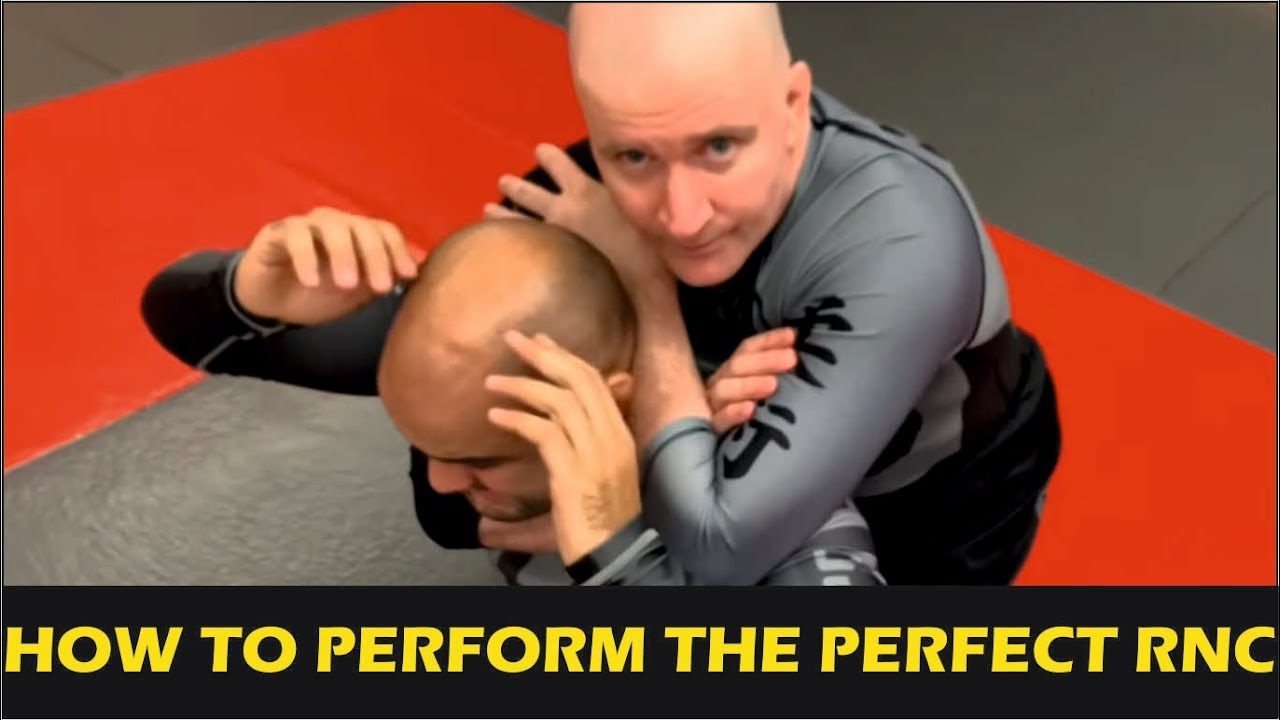
A clean mental model
When you train the rear naked choke, think in this order:
- Control their upper body
- Stabilize the back
- Win the hand fight
- Insert the choking arm far
- Seal the structure
- Finish with full-body pressure
That order helps beginners stay calm. It also helps advanced students troubleshoot where a finish breaks down. If the choke fails, the answer is usually earlier in the chain.
Common Mistakes That Sabotage Your Choke
A lot of failed rear naked chokes do not fail because the move is weak. They fail because the setup leaks in small places.
Those leaks matter. According to Grapplearts’ breakdown of rear naked choke mechanics and pitfalls, low grips increase defense success by 40-50%, an improper thumb-down control hand allows 70% of overhead escapes, and a lack of hooks leads to 60% of position losses before the finish is attempted. That is a strong reminder that tiny technical errors can destroy a great position.
The mistake beginners make first
Most beginners think the problem is finishing power.
Usually, the core problem is structure.
They squeeze harder when they should adjust their arm depth. They crank the face when they should improve the angle. They rush the neck when they should fix the seatbelt. This is why live coaching matters so much. A good instructor can see the exact breakdown in seconds.
Common RNC Mistakes and Corrections
| Mistake | Why It Fails | The BJJ Correction |
|---|---|---|
| Low seatbelt grip | The opponent can grab and peel the arms more easily | Keep the control high near the shoulder line and neck |
| Thumb-down control hand | It opens pathways for overhead escapes | Use a thumb-up or palm-to-shoulder structure behind the head |
| Loose or missing hooks | The opponent can rotate, slide, or shake free before the finish develops | Reinsert active hooks and stabilize the hips before chasing the choke |
| Shallow choking arm | You end up attacking the jaw or face instead of sealing the neck | Win the hand fight and slide the arm deeper before locking the grip |
| Pushing the head forward | It creates space and weakens your compression | Keep the structure compact and bring the elbows together instead |
| Trying to finish too early | You trade control for a rushed attack | Pause, rebuild back control, then resume the sequence |
Myths that keep people stuck
One of the biggest myths is that any pressure around the head counts as a good choke.
It does not.
A painful face crank may force a reaction in training, but it is not the same as a clean rear naked choke. A properly applied choke is about structure and blood flow restriction. If your training partner’s face hurts but their body still feels mobile and their hands are still working, your mechanics probably need attention.
Another myth is that crossing your feet or squeezing the legs wildly will solve upper body problems. It will not. Good leg control helps, but it does not replace strong shoulder control and hand positioning.
What genuine correction looks like
A qualified coach does more than say “squeeze.”
They might tell you to raise your seatbelt one inch. They might rotate your elbow slightly. They might show you that your non-choking hand is helping the opponent escape. These details are hard to catch alone, especially for beginners from Lindenhurst, North Lindenhurst, Farmingdale, or Massapequa Park who are just starting to spar.
That is why in-person instruction beats copying clips. Videos can show the move. They cannot feel your timing or stop you the moment your structure breaks.
If your choke feels like hard work every time, the answer is usually not more effort. The answer is cleaner mechanics.
A better way to judge your rear naked choke
Do not judge the technique by whether you can force taps on less experienced people.
Judge it by better standards:
- Can you keep the back while they defend?
- Can you return to control when the neck disappears?
- Can you finish without straining your arms?
- Can you apply it safely and cleanly in live rounds?
Those questions move your training in the right direction. They also reflect the true value of BJJ. You are not collecting moves. You are building a dependable system.
Drills for Skill Development on Long Island
A rear naked choke becomes reliable through repetition, but not mindless repetition.
You need drills that teach position, timing, and calm decision-making. You also need training that stays safe. A properly applied rear naked choke can render someone unconscious in an average of 8.9 seconds, and that speed comes from blood flow restriction rather than pain, as described in the rear naked choke overview on Wikipedia. That is why every drill should be done with communication, control, and immediate respect for the tap.
Solo drills that build the right habits
Solo work cannot replace live partners, but it can sharpen the movements that beginners struggle with most.
Try these:
- Elbow path rehearsal: Practice bringing your choking elbow across an imaginary center line without flaring it wide.
- Seatbelt posture drill: Sit tall, clamp your elbows in, and rehearse a high over-under harness position.
- Chest expansion finish motion: Practice the final tightening motion without jerking your shoulders upward.
- Hip-follow movement: Move side to side on the floor while keeping your upper body compact, as if following a scrambling opponent.
These drills are useful for adults training after work in Lindenhurst, for hobbyists from Babylon and Copiague, and for older students who want technical repetition without hard impact.
Partner drills that effectively transfer
Good partner drills isolate one problem at a time.
A few examples work especially well:
Seatbelt retention rounds
Start with back control and no choke allowed. One partner tries to maintain upper body control while the other tries to rotate and escape.Hand-fight only rounds
Begin with a high seatbelt. The defender protects the neck. The attacker works only on clearing hands and improving position.Deep arm entry drill
Move slowly from seatbelt to clean choking-arm placement. No finishing squeeze. Focus only on depth and alignment.Catch and release finishes
Apply the final structure lightly, get the position, then release and reset. This teaches precision without turning every rep into a hard finish.
If you want extra training ideas between classes, libraries of effective drills can help students organize practice with more intention.
Drilling for self-defense and law enforcement
The rear naked choke has obvious value in sport, but its control principles matter just as much outside competition.
For law enforcement and security professionals on Long Island, the key lesson is not “chase the submission at all costs.” The lesson is how to control the upper body, stop movement, and apply force responsibly when needed. In self-defense settings, the ability to stabilize someone from behind can be far more useful than trying to trade strikes.
That said, training context matters. Sport rounds, standing control, and self-defense scenarios all create different problems. A quality instructor helps students understand where techniques overlap and where they must be adapted.
A weekly practice rhythm
A simple routine works well for many students:
- One session for mechanics: Focus on clean reps at low speed.
- One session for positional sparring: Start from the back repeatedly.
- One session for live rounds: Try to apply the sequence under resistance.
- One recovery or solo session: Review posture, elbow path, and movement.
For added conditioning and movement work, this page on the best jiu-jitsu workouts gives useful support training ideas.
Drill slowly enough that you can feel where your control breaks. Speed should confirm skill, not hide mistakes.
Understanding Defenses to Sharpen Your Attack
The smartest way to improve your rear naked choke is to study defense from the attacker’s side.
That changes your mindset. You stop seeing the choke as one move and start seeing it as a prediction game. The opponent tucks the chin, grabs your wrist, hides the shoulders, turns toward the underhook side, or tries to slide the back to the mat. Each defense gives you information.
The chin tuck is not the primary battle
Beginners get obsessed with the chin.
They think the defender’s tucked chin is the entire problem. Usually it is not. The underlying issue is that the attacker has lost the upper body and hand-fighting battle that should have opened the neck in the first place.
When someone tucks the chin, ask a better question. Are their shoulders still trapped? Are their hands fully occupied? Is your head close? If those answers are no, your focus should return to control, not forcing the face.
Hand fighting tells you what comes next
Defenders almost always reveal their priorities through their grips.
If they use two hands on your choking arm, they may be exposing space elsewhere. If they focus heavily on wrist control, your upper-body retention may need attention. If they start rotating their shoulders, they are preparing to escape more than they are defending the neck.
A strong attacker reads these reactions in real time.
That is the chess match people talk about in BJJ. Not because jiu-jitsu is abstract, but because every movement creates a response. Caio Terra’s approach fits here too. Technical grappling is often about staying one beat ahead, not one squeeze stronger.
How attackers stay ahead
A useful attacking mindset looks like this:
- If they hide the neck, keep the back
- If they grab the wrist, improve the hand-fight
- If they turn their shoulders, restore upper body control
- If they over-defend one side, attack through the opening they created
That approach keeps you from becoming desperate. It also helps advanced students from the Lindenhurst area turn the rear naked choke into a system instead of a single finish attempt.
Why live training matters most here
This part cannot be learned well from memorization alone.
You need to feel when a defender is strong, tired, panicked, slippery, or technically calm. You need rounds where a partner gives realistic resistance and changes timing without warning. That is how your attack becomes adaptable.
Skilled rear naked choke attackers do not force one answer. They guide the defender into giving them one.
Start Your BJJ Journey in Lindenhurst Today
The rear naked choke teaches a bigger lesson than how to finish a fight.
It shows why Brazilian Jiu-Jitsu works. The person with better position, sharper mechanics, and calmer decision-making can control and finish someone without needing to overpower them. That is why BJJ remains such a strong choice for fitness, self-defense, and practical skill development.
It also shows why instruction matters. You can learn the outline of a choke online. You cannot build timing, pressure, and judgment from videos alone. A strong coach shortens the learning curve, keeps training safe, and helps students from Lindenhurst and nearby towns develop habits that hold up in live rounds.
Caio Terra’s technical philosophy points in the same direction. Clean details. Strong fundamentals. Mechanical advantage before strength. That is the kind of approach that serves beginners, experienced grapplers, older adults, and law enforcement professionals alike.
If you are local and ready to begin, this guide on how to start Brazilian Jiu-Jitsu is a useful first step. If you run a gym or teach private sessions yourself, tools like booking software for sports coaches can also help organize classes and student scheduling more smoothly.
The next step is simple. Train in person. Ask questions. Let a good instructor correct the details. That is how the mma rear naked choke stops being something you recognize and becomes something you can perform.
If you are in Lindenhurst, Babylon, West Babylon, Copiague, Amityville, Massapequa, or another nearby Long Island community, Korfhage BJJ | Caio Terra Academy Long Island offers a technical, beginner-friendly path into genuine Brazilian Jiu-Jitsu. Located at 99 W. Hoffman Ave in Lindenhurst, the academy teaches a structured, mechanical advantage-based curriculum for adults, kids, seniors, competitors, and law enforcement. New students can get started with a $99 unlimited classes trial, which gives you the chance to experience high-level instruction, a clean training environment, and a supportive community without guesswork.